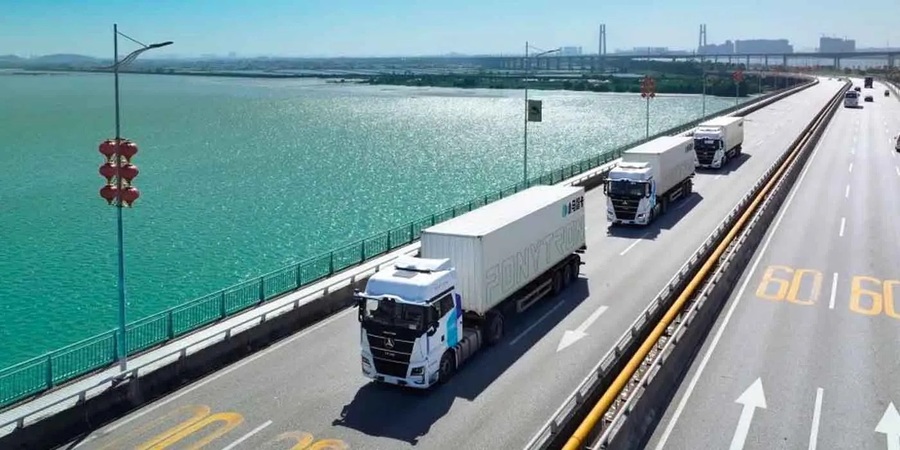

Self-driving trucks are moving beyond closed demonstrations in China, where autonomous vehicles already operate on selected public roads and freight routes. Pony.ai is among the companies preparing larger deployments, including new battery-electric trucks and driverless platoons. The development could reshape logistics costs, fleet maintenance and the demands placed on commercial tyres.
China has become an important testing ground for autonomous commercial vehicles. Regulations remain regional, but developers have secured permits covering public-road testing, expressways and selected commercial freight services.
Pony.ai received its first robot-truck testing permit in Guangzhou in 2020. It later expanded onto national highways around Beijing. In January 2024, the company secured approval for cross-provincial testing across the Beijing-Tianjin-Hebei freight network.
By December 2024, Pony.ai had also received permission to test a “1+N” platoon on cross-provincial expressways. The lead vehicle retained a safety operator, while the following truck could operate without anyone behind the wheel.
The company reported operating more than 190 autonomous trucks by April 2025. Its partnerships include Sinotrans, with vehicles providing routine transport services for logistics customers.
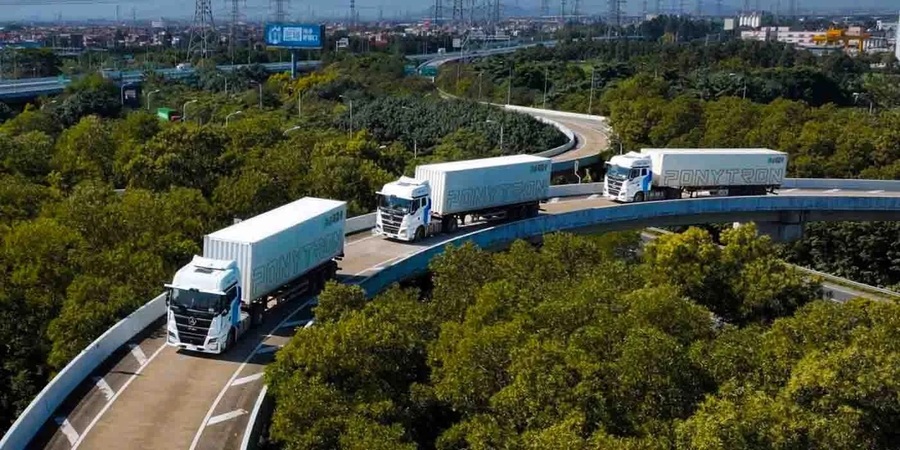
Pony.ai has since announced a fourth-generation autonomous truck programme with SANY Truck and Dongfeng Liuzhou Motor.
The first vehicles will use battery-electric platforms and are intended for production at thousand-unit scale. Initial fleet deployment is scheduled during 2026, although actual volumes will depend on approvals and operating conditions.
Pony.ai says sharing components with its latest robotaxi system has reduced the autonomous driving kit’s bill-of-materials cost by about 70%. It also projects that a platoon containing one human-driven truck and four driverless vehicles could reduce freight costs per kilometre by 29%.
Those figures are company projections based on current trial scenarios. They will require validation under sustained commercial operation.
For motorway users, one possible attraction is less emotional than operational. An autonomous truck does not become impatient, distracted or determined to complete a marginal overtaking manoeuvre.
That does not mean driverless lorries will remain permanently in one lane. Automated systems can be designed to change lanes when required by routes, traffic conditions or safety rules.
However, their movements should be governed by programmed limits rather than driver judgement. That could make speed, spacing and lane changes more consistent, particularly when trucks operate as connected platoons.
The motorway joke therefore contains a serious point. Predictable driving behaviour could influence congestion, fuel consumption, braking demand and vehicle wear.
Removing the driver does not remove the vehicle’s contact with the road. Autonomous systems still depend on tyres providing reliable grip, pressure retention and load capacity in changing conditions.
Heavy electric trucks can also place different demands on commercial tyres. Battery weight, high torque and intensive operating cycles may affect wear, heat generation and replacement planning.
Connected tyre systems could therefore become an important part of autonomous freight operations. Pressure, temperature, tread and load data may need to feed directly into vehicle control and fleet maintenance platforms.
Tyre News has examined this direction through Michelin’s universal tyre digital twin, which estimates grip, wear and pressure from vehicle data. The technology is intended to support predictive maintenance and future autonomous vehicles.
Recent coverage of truck tyre technology and fleet artificial intelligence at RTX 2026 also showed how automated inspections and connected fleet tools are entering everyday maintenance.
For tyre manufacturers and service providers, autonomous freight could create fleets with highly consistent routes and detailed operating records.
That may make tyre performance easier to measure. Operators could compare wear, rolling resistance and casing life across vehicles completing almost identical duties.
It could also increase expectations. An autonomous truck cannot identify a damaged tyre during a traditional walk-round inspection unless suitable monitoring and inspection systems replace that task.
Service providers may therefore need to combine physical tyre maintenance with remote condition monitoring, predictive alerts and planned intervention. Tyre News has previously highlighted how pressure management, telematics and casing care support fleet efficiency.
Driverless trucks are unlikely to appear across every Asian motorway at once. Regulation, insurance, infrastructure and public confidence will continue to shape deployment.
China has also increased scrutiny of autonomous vehicle safety following incidents elsewhere in the sector. Pony.ai said in May 2026 that its operations had not been affected by a national review, although the episode showed how quickly regulatory conditions can change.
The immediate development is therefore not unrestricted autonomy. It is the gradual expansion of supervised routes, controlled platoons and commercial operations where the economics can be measured.
Self-driving trucks may not end motorway frustration. They may still change lanes and they will still need maintaining. However, their arrival could make freight movements more predictable while creating a more data-intensive market for truck tyres and fleet services.
Tagged with: autonomous trucks, driverless lorries, Pony.ai, commercial vehicle tyres, truck tyres, connected tyres, fleet technology, predictive maintenance, tyre monitoring, freight logistics, electric trucks, autonomous freight
Editorial Standards & Disclaimer
Tyre News Media is an independent industry publication. Our reporting is based on information available at the time of publication, including company announcements, regulatory filings, official data, research and other sources considered reliable.
Articles may include independent analysis and editorial interpretation. Where appropriate, company statements and third-party claims are attributed to their source. Analysis, estimates and forward-looking observations should not be read as statements of established fact.
Tyre News Media takes reasonable steps to ensure accuracy but welcomes corrections, clarifications and responses from organisations or individuals covered in our reporting. If you believe information is inaccurate or requires clarification, please contact info@tyrenews.co.uk. Material errors will be corrected as appropriate.
Commercial relationships, advertising and sponsorship do not determine Tyre News Media's editorial coverage or conclusions.

_0%20(1).png)













%20(1).jpeg)