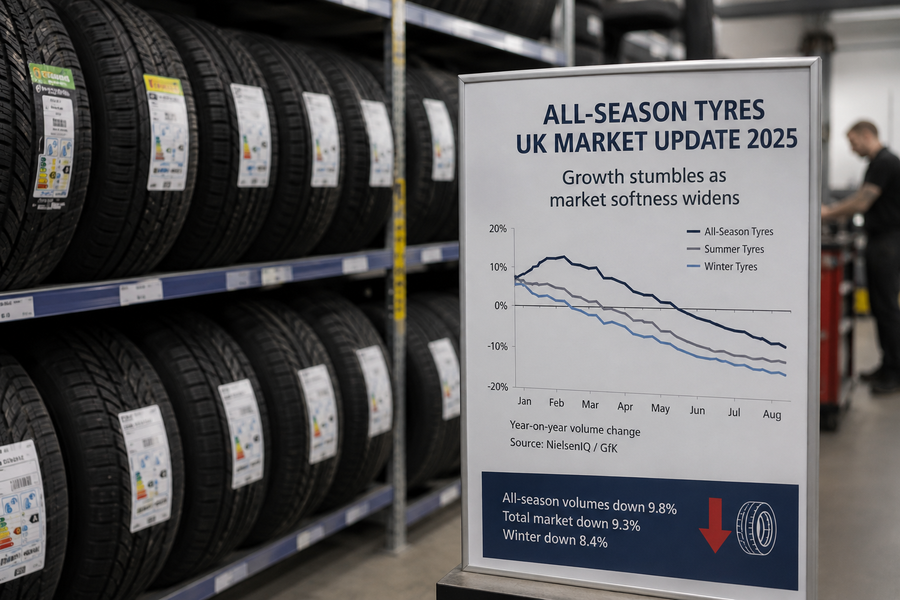

The UK all-season tyre market lost momentum during the first eight months of 2025. NielsenIQ and GfK data show volumes falling 9.8% year on year. The decline was slightly steeper than the wider car tyre market and signals that softer consumer demand has reached one of the trade’s most resilient categories.
All-season tyres had been among the strongest-performing areas of the UK replacement market. The category benefited from changing driver habits and greater consumer awareness of year-round products.
Milder winters also reduced the appeal of maintaining separate summer and winter fitments for many motorists. Retailers responded by expanding all-season ranges across premium, mid-market and value price points.
However, the latest figures suggest that this momentum weakened during 2025. All-season sell-out volumes fell by 9.8% during the eight months covered by the NIQ/GfK data.
That compares with a 9.3% decline across the overall UK car tyre market. The difference is narrow but commercially significant. It shows that all-season tyres did not provide the same degree of protection against falling demand.
The downturn was not limited to all-season products. Summer tyre volumes declined by 9.3% year on year. Winter tyre volumes fell by 8.4%.
These figures point to broad pressure across the replacement market rather than a simple shift between seasonal categories. Consumers may be delaying replacement purchases, driving fewer miles or trading down during a period of household budget pressure.
Tyre News has also reported that European consumer replacement tyre sales declined during 2025. That wider decline affected summer and winter demand across the region.
The UK figures therefore appear consistent with a more challenging European replacement environment. However, they also contrast with continuing manufacturer investment in all-season products.
Manufacturers are still broadening all-season ranges for cars, sport utility vehicles and electric vehicles. Tyre News recently examined how Pirelli, Continental and Sailun are widening all-season choice across different price and performance tiers.
Yokohama has also introduced its BluEarth-AllSeason2 for European passenger cars, SUVs and battery electric vehicles. The launch reflects continued supplier confidence in the category’s longer-term relevance.
This creates a more complicated picture for wholesalers and retailers. Product availability is growing while total UK sell-out demand is weakening.
In practice, businesses may need to manage stock more carefully and focus on the applications where all-season tyres offer a clear customer benefit.
The NielsenIQ and GfK figures indicate that all-season tyres remain exposed to the same economic pressures affecting the wider market.
The segment’s underlying appeal has not necessarily disappeared. Drivers still value year-round convenience, particularly where severe winter conditions are uncommon.
However, product preference alone cannot offset a substantial fall in replacement activity. Even a growing category can contract when consumers postpone purchases across the entire market.
The next test will be whether all-season demand recovers faster than summer and winter volumes. A stronger rebound would support the view that 2025 represented a temporary interruption.
Continued underperformance could instead suggest that the UK segment is entering a more mature phase after several years of expansion.
For now, the data points to a softer replacement market in which no seasonal category is immune.
Tagged with: UK tyre market, all-season tyres, replacement tyre sales, NielsenIQ, GfK, summer tyres, winter tyres, consumer demand, tyre retail, tyre wholesale, market volumes, seasonal tyres
Editorial Standards & Disclaimer
Tyre News Media is an independent industry publication. Our reporting is based on information available at the time of publication, including company announcements, regulatory filings, official data, research and other sources considered reliable.
Articles may include independent analysis and editorial interpretation. Where appropriate, company statements and third-party claims are attributed to their source. Analysis, estimates and forward-looking observations should not be read as statements of established fact.
Tyre News Media takes reasonable steps to ensure accuracy but welcomes corrections, clarifications and responses from organisations or individuals covered in our reporting. If you believe information is inaccurate or requires clarification, please contact info@tyrenews.co.uk. Material errors will be corrected as appropriate.
Commercial relationships, advertising and sponsorship do not determine Tyre News Media's editorial coverage or conclusions.

_0%20(1).png)













%20(1).jpeg)