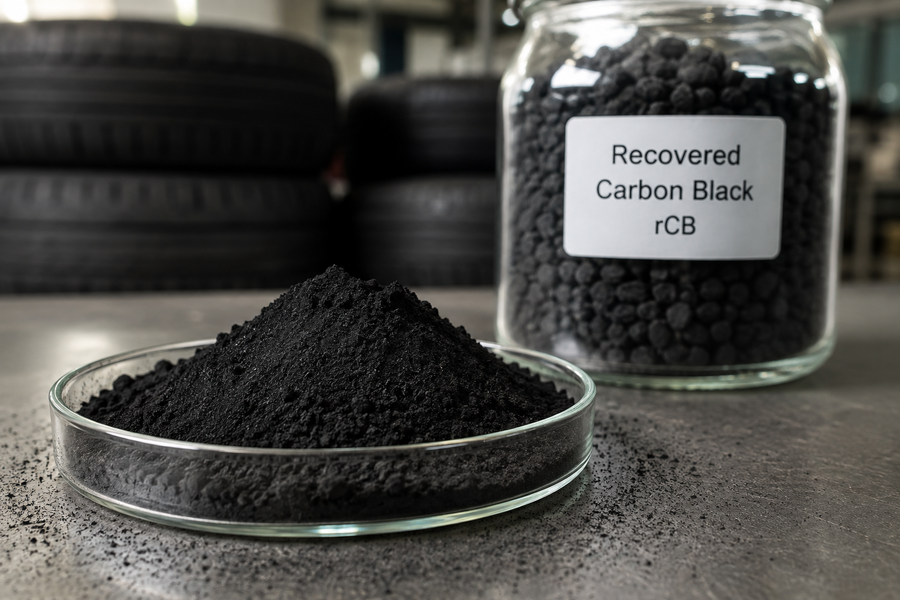

Recovered carbon black is moving beyond technical validation and into longer-term tyre industry supply relationships. Yet commercial adoption is developing faster than the market infrastructure around it. For procurement teams, the next challenge is not simply proving that rCB can work in tyres, but making products sufficiently comparable, dependable and priceable to support mainstream sourcing.
Recovered carbon black has spent much of the past decade facing a technical question: can material recovered from end-of-life tyres return to demanding rubber applications?
Increasingly, individual products are demonstrating that they can. Michelin has used recovered carbon black from Scandinavian Enviro Systems in specialist racing tyre applications, including Le Mans and MotoE, while Continental has moved beyond trials with Pyrum Innovations into long-term sourcing arrangements. These developments do not mean every rCB product is interchangeable with conventional carbon black, or with another producer's rCB. They do show that the industry's central challenge is shifting from whether the material can be used towards how it can be purchased reliably at industrial scale.
That is a significantly different problem.
For purchasing departments, a commodity needs more than technical viability. Buyers need recognised specifications, repeatable quality, meaningful competition between qualified suppliers, sufficient volume, dependable logistics and a mechanism through which competing offers can be compared. On several of those measures, the recovered carbon black market remains under construction.
An important part of that infrastructure arrived with ASTM D8632-25, published in 2025 and attracting wider industry attention in 2026. The classification system covers recovered carbon black used in rubber products, using characteristics including inorganic content and toluene transmittance to differentiate material.
The commercial significance is straightforward. ASTM says the standard was developed at industry's request to make it easier to compare recovered carbon black products from different manufacturers, following industry initiatives around developing purchasing specifications.
Without common classifications, a purchasing team evaluating two rCB offers may not necessarily be comparing equivalent materials. Differences in supplier specifications, analytical methods and product characteristics can mean qualification remains attached to a particular producer and product rather than to a broadly recognised grade that can be sourced elsewhere.
ASTM D8474-23 provides another piece of that infrastructure. The thermogravimetric analysis method establishes a common approach to determining organic residue, fixed carbon and ash in rCB, with applications including certificates of analysis and off-take agreements.
The direction is important, but standards alone do not create interchangeability.
A classification system can make products easier to describe and compare without demonstrating that two materials will behave identically in a tyre compound. Manufacturers still need to establish whether changing source affects processing, formulation or finished-product performance. Until sufficiently comparable grades can be qualified across multiple producers, rCB purchasing is likely to retain more of the characteristics of strategic sourcing than conventional commodity procurement.
Continental's relationship with Pyrum illustrates how far industrial qualification has progressed.
The companies signed a ten-year framework agreement in July 2024 covering rCB from at least two Pyrum plants. Continental also agreed to supply end-of-life tyres to Pyrum and make an advance payment against future recovered carbon black deliveries.
Pyrum subsequently reported in 2026 that Continental had granted unlimited delivery approval for pelletised ThermoTireBlack recovered carbon black produced at its Dillingen/Saar facility. That is commercially more significant than another successful material trial because it indicates progression into an approved industrial supply relationship.
Pyrum has also developed a long-term circular supply arrangement with Schwalbe. In 2025, the companies announced a ten-year framework covering both recovered carbon black supply and the delivery of end-of-life tyres to Pyrum, with a long-term base price structure whose detailed commercial terms have not been publicly disclosed.
These agreements demonstrate one way in which the emerging market is compensating for infrastructure it does not yet possess.
Long-term contracts can give producers demand visibility and support investment while providing tyre companies with greater confidence over future supply. Close producer-customer relationships can also facilitate technical qualification while products and production processes continue to mature.
But bilateral contracting is not the same as transparent market pricing. The economics of one privately negotiated agreement cannot readily tell another purchasing department what an equivalent tonne of recovered carbon black should cost.
That leads to perhaps the least developed part of the rCB commercial architecture: price discovery.
A functioning commodity market requires buyers to understand not only what they are purchasing, but where the market is pricing comparable material.
Recovered carbon black does not yet have a widely accepted, transparent benchmark capable of performing that function across the market. Commercial negotiations can reference conventional carbon black grades and take account of factors such as quality, region, volume and sustainability attributes, but that is different from having a broadly recognised rCB price against which competing offers can be evaluated.
The problem is deeper than simply persuading somebody to publish an index.
A useful benchmark needs to represent a sufficiently standardised product. If two recovered carbon blacks have materially different inorganic content, residual hydrocarbons, surface characteristics or performance in a compound, publishing a single "rCB price" risks creating the appearance of transparency without providing a meaningful purchasing comparison.
Standardisation and price discovery are therefore closely linked. The industry's standards work could eventually provide some of the product definitions required for more sophisticated price reporting, but only if classifications gain broad adoption and correspond sufficiently closely to the parameters purchasing departments and compound developers actually use.
This also helps explain why rCB remains different from a conventional commodity from the buyer's perspective. Procurement teams must frequently determine whether two materials are technically comparable before they can establish whether the prices being quoted are commercially comparable.
That additional qualification burden carries a cost even when the material itself is competitively priced.
Production scale is another part of the equation, and significant projects are beginning to increase available capacity.
LD Carbon's new Dangjin facility in South Korea, for example, has been designed to process around 50,000 tonnes of end-of-life tyres annually and produce approximately 20,000 tonnes of recovered carbon black, alongside pyrolysis oil and other recovered materials.
European projects are similarly attempting to move tyre pyrolysis from relatively small recycling operations towards larger industrial supply chains, often supported by long-term tyre industry relationships and off-take commitments.
Increasing capacity matters. Large tyre manufacturers need suppliers capable of supporting predictable multi-year requirements, and a deeper production base should eventually give procurement departments more sourcing options.
But scale alone does not create a commodity.
Recovered carbon black properties can be influenced by the composition of the tyre feedstock and by pyrolysis and post-treatment conditions. Recent peer-reviewed work examining end-of-life tyre pyrolysis and recovered carbon black continues to highlight feedstock composition, processing temperature, residence time and downstream treatment as important influences on material characteristics.
The commercial challenge is therefore not simply producing more rCB. It is producing larger quantities within sufficiently predictable specifications across different plants and, ultimately, different suppliers.
A market containing several large producers whose materials each require separate technical treatment is more competitive than a single-source market, but it is still some distance from genuine commodity-style procurement.
The next stage of rCB development will depend on several pieces of market infrastructure advancing together.
Standards need to become sufficiently detailed and widely adopted to support meaningful comparison. Producers need to demonstrate repeatability at industrial volumes. Tyre manufacturers need enough independently qualified sources to reduce dependence on individual plants, while logistics and documentation must become predictable enough to support multi-site purchasing.
Price transparency can then develop around products that buyers recognise as genuinely comparable.
None of this suggests recovered carbon black has failed to commercialise. The opposite interpretation may be more useful. The industry's need for standards, long-term supply contracts and clearer pricing mechanisms reflects rCB's movement beyond demonstration projects and towards serious raw-material procurement.
The question facing the sector has therefore changed.
It is no longer simply whether recovered carbon black can be incorporated into another tyre compound. The more important test is whether a purchasing department can specify an accepted grade, obtain comparable offers from several qualified producers, understand the prevailing market price and change supply without effectively beginning the technical qualification process again.
That distinction matters to more than tyre manufacturers. Pyrolysis developers need credible off-take markets to finance new capacity. Investors need to understand whether projected output will enter a liquid market or remain dependent on individual customer relationships. Testing companies and standards organisations have a role in making products comparable, while established carbon black businesses must decide how recovered material fits alongside their conventional portfolios.
The industry's progress suggests rCB is getting closer to answering the technical question that dominated its early development. Its next challenge is harder because no producer can solve it alone.
When specification, interchangeability, supply depth and price discovery begin working together, recovered carbon black will have crossed a more consequential threshold than another successful tyre trial. It will have started behaving like a commodity.
Tags: recovered carbon black, rCB, tyre manufacturing, tyre pyrolysis, carbon black, tyre procurement, rCB pricing, ASTM D8632, tyre recycling, circular economy
Editorial Standards & Disclaimer
Tyre News Media is an independent industry publication. Our reporting is based on information available at the time of publication, including company announcements, regulatory filings, official data, research and other sources considered reliable.
Articles may include independent analysis and editorial interpretation. Where appropriate, company statements and third-party claims are attributed to their source. Analysis, estimates and forward-looking observations should not be read as statements of established fact.
Tyre News Media takes reasonable steps to ensure accuracy but welcomes corrections, clarifications and responses from organisations or individuals covered in our reporting. If you believe information is inaccurate or requires clarification, please contact info@tyrenews.co.uk. Material errors will be corrected as appropriate.
Commercial relationships, advertising and sponsorship do not determine Tyre News Media's editorial coverage or conclusions.
















%20(1).jpeg)