
A Peugeot Expert with 488,100 miles may be an extreme example of vehicle longevity, but the more significant development for Britain's tyre trade is happening across millions of less remarkable cars and vans. Official data shows the vehicle parc is getting older while road traffic remains high, extending the period in which motorists depend on the replacement tyre and maintenance market.
HiQ Tyres & Autocare says its analysis of almost 60,000 vehicles identified a 12-year-old Peugeot Expert MPV showing 488,100 miles at one of its Northamptonshire centres. Without the underlying dataset, that figure should be treated as an attributed example rather than evidence that Britain's vehicles as a whole are accumulating unusually high mileages.
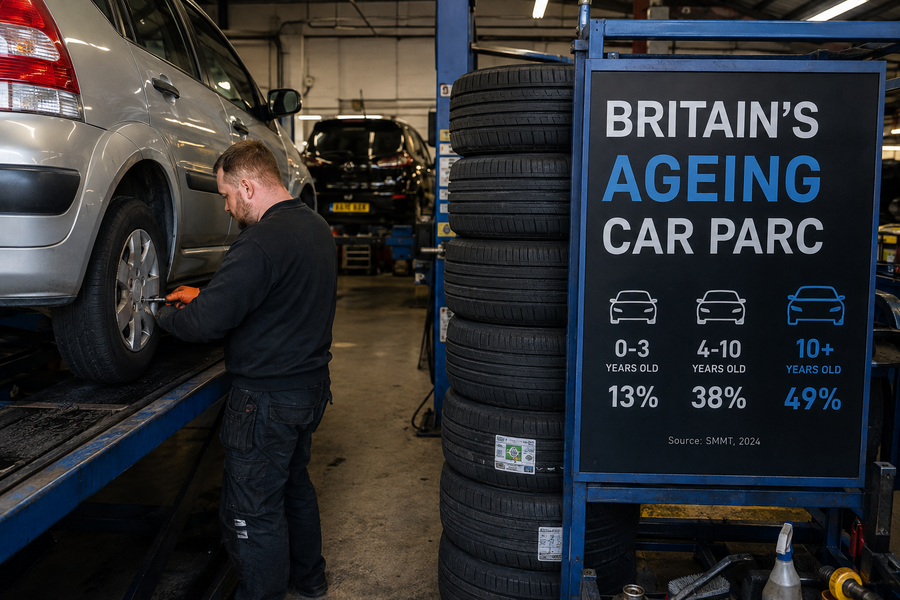
The wider market trend, however, can be established independently. SMMT's latest Motorparc figures put 36.68 million cars on Britain's roads in 2025, with a record 45.7% more than 10 years old. Average car age reached 9.7 years, also a record. That means approximately 16.8 million cars are now beyond their first decade of use.
Government licensing statistics point in the same direction. The Department for Transport puts the average age of a licensed UK car at 10 years at the end of 2025, compared with nine years five years earlier. Light goods vehicles averaged nine years, up from eight in 2020.
For the tyre aftermarket, this changes the commercial significance of vehicle longevity. The opportunity is not that every older vehicle necessarily travels more miles. It is that vehicles remaining in service for longer continue to require tyres, MOT preparation, alignment, brakes, suspension and other maintenance long after their original owners may have moved on.
That distinction matters. Government analysis of MOT data has previously found that overall MOT failure rates increase with both vehicle mileage and age. In the Department for Transport's assessment of possible changes to MOT testing, failure rates rose progressively through higher odometer bands, reaching 41% among vehicles above 100,000 miles in the dataset analysed. The same assessment also found failure rates increasing as vehicles aged.
Those figures cover overall MOT failures rather than tyres specifically, so they cannot establish that high-mileage vehicles are proportionately more likely to fail on tyres. They do, however, demonstrate why age and mileage need to be treated separately when assessing aftermarket demand.
The latest DVSA defect statistics show why the question matters to the tyre sector.
For Class 3 and 4 vehicles, which include cars and light vans up to 3,000kg, tyre defects were recorded on 6.39% of initial tests during 2024/25. In the first quarter of 2025/26 the figure was 6.23%.
More strikingly, tyres accounted for around 60% of dangerous defects recorded within the Class 3 and 4 category in both periods. The statistic does not mean 60% of all failed vehicles had dangerous tyre defects. DVSA warns that failed tests can contain multiple failure items, so defect-category percentages must not be treated as simple vehicle failure rates. Nevertheless, it underlines the disproportionate safety significance of tyres within MOT inspection.
Tyre News Media has previously reported on official data showing 3.1 million tyre defects associated with MOT failures over a 13-month period, including 2.38 million classified as dangerous. That evidence already established the scale of tyre condition problems reaching the MOT bay. The ageing-parc data adds a different commercial dimension: the population requiring those inspections and interventions is remaining on the road for longer.
The trend also supports the wider workshop economics examined in our recent analysis of how Halfords is rebuilding autocentre economics beyond tyre replacement. An older parc increases the relevance of servicing, maintenance and repair alongside tyres, potentially favouring operators able to capture a greater share of each vehicle's remaining lifetime spend.
The light commercial market deserves particular attention because vehicle age is combining with unusually high utilisation.
Vans travelled 59.2 billion miles on Great Britain's roads in the 12 months to March 2026, according to provisional Department for Transport figures. That was 1.1% higher than the previous year and 10.6% above the comparable pre-pandemic level. Car and taxi traffic, meanwhile, reached 262.7 billion miles, up 2.4% year on year and broadly back to its pre-pandemic level.
This makes HiQ's exceptionally high-mileage Peugeot Expert more useful as an illustration of the working-vehicle market than as proof of a national mileage trend. Commercial vehicles accumulate mileage because they produce economic value while moving, and the UK van parc is now both older than it was five years ago and travelling materially further than before the pandemic.
For tyre retailers serving tradespeople, delivery operators and small fleets, that combination can increase the importance of inspection, replacement planning and minimising downtime. A tyre purchase on a working van is not simply a discretionary consumer expense. Condition and availability can directly influence whether a vehicle remains productive.
The central aftermarket opportunity therefore lies in vehicle lifetime rather than mileage alone.
A car retained for another two or three years remains exposed to replacement tyre demand for another two or three years. It also remains within the market for MOT work, suspension, steering, brakes, batteries and alignment. With almost half Britain's cars now more than a decade old, this is no longer a niche segment of the parc.
That does not guarantee higher tyre volumes. Older cars may cover fewer miles annually, and motorists operating lower-value vehicles may also be more price-sensitive. The effect on premium, mid-range and budget tyre mix therefore needs evidence rather than assumption.
For retailers and wholesalers, the more useful question may be how vehicle longevity changes customer value. A business that views an older vehicle only as a low-value tyre sale may overlook the cumulative maintenance requirement created by keeping that vehicle on the road for several additional years.
The safety challenge reinforces the same point. Recent Tyre News Media coverage of tyre inspection data has shown a substantial population reaching workshops close to, or below, important tread thresholds, while MOT evidence continues to place tyres among the most consequential safety defects.
DVSA's anonymised MOT database provides the opportunity to test the relationship more precisely. The latest release contains 2025 test outcomes, make and model information, odometer readings and reasons for failure, with the 2025 results and failure-item extracts added on 22 June 2026.
The next analytical step is therefore not another survey. It is to link those national MOT records and calculate tyre-defect incidence by both vehicle age and accumulated mileage.
That would allow a more commercially useful question to be answered: does tyre-defect risk rise primarily because a vehicle is old, because it has travelled a high total mileage, or because the two factors interact?
Until that analysis is completed, the evidence supports a narrower but still important conclusion. Britain's vehicle parc is ageing, millions of cars are remaining in service beyond 10 years, van utilisation is well above its pre-pandemic level, and tyre defects continue to represent a significant component of MOT safety intervention.
The half-million-mile Peugeot is the attention-grabber. The more consequential development for the tyre trade is the millions of ordinary vehicles that are simply staying on Britain's roads for longer.
Tags: UK tyre aftermarket, ageing car parc, MOT tyre defects, vehicle mileage UK, tyre replacement, car parc age, van tyres, fleet tyres, tyre retail, vehicle maintenance
Editorial Standards & Disclaimer
Tyre News Media is an independent industry publication. Our reporting is based on information available at the time of publication, including company announcements, regulatory filings, official data, research and other sources considered reliable.
Articles may include independent analysis and editorial interpretation. Where appropriate, company statements and third-party claims are attributed to their source. Analysis, estimates and forward-looking observations should not be read as statements of established fact.
Tyre News Media takes reasonable steps to ensure accuracy but welcomes corrections, clarifications and responses from organisations or individuals covered in our reporting. If you believe information is inaccurate or requires clarification, please contact info@tyrenews.co.uk. Material errors will be corrected as appropriate.
Commercial relationships, advertising and sponsorship do not determine Tyre News Media's editorial coverage or conclusions.




















%20(1).jpeg)