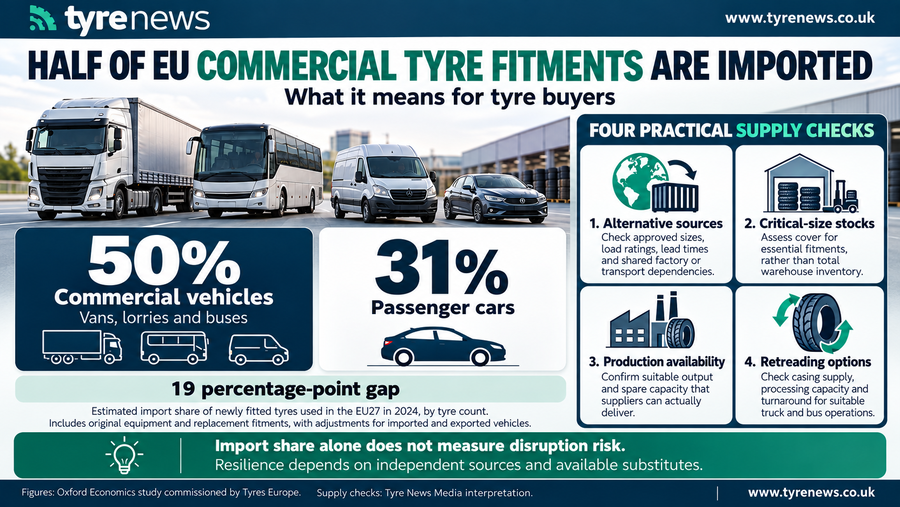

Oxford Economics estimates that imports accounted for 50% of newly fitted commercial-vehicle tyres used in the EU in 2024. For buyers, resilience depends on alternative sources, critical-size stocks, production availability and retreading options.
Imported tyres accounted for an estimated 50% of newly fitted tyres used on commercial vehicles in the EU in 2024, compared with 31% for passenger cars. The 19-percentage-point gap points to different sourcing patterns and raises a practical question for fleet buyers and distributors: how readily could interrupted supply be replaced?
The study commissioned by Tyres Europe measures fitments across the EU27 by tyre count. It captures tyres entering use through vehicle production and replacement channels, including tyres fitted to imported vehicles and excluding EU-made tyres fitted to vehicles exported from the bloc. Commercial road vehicles include vans, lorries and buses.
As TNM previously reported, these estimates concern tyres brought into use, rather than replacement sales alone.
For buyers, the significance lies in how three factors interact: reliance on imports, concentration of supply and the availability of substitutes. A higher import share does not establish greater disruption risk by itself. It matters most when the affected products are difficult to replace.
Tyres Europe’s Q2 2026 update, prepared by Astutus Research, provides a newer view of import origins.
Page 4 reports that imports from Thailand and Vietnam accounted for almost 61% of covered truck and bus import volume in January–May 2026, compared with 57% a year earlier and under 30% in 2019. China accounted for 16% and India for 6%.
Page 3 shows a different pattern for passenger car and light truck imports over the same period. China’s share fell from 72% to 58%, while ASEAN-origin imports accounted for 19.9%. Korea and Japan together accounted for 14.6%.
The datasets have important differences. The newer figures cover EU27 plus UK imports from non-European markets, excluding Serbia and Türkiye, and distinguish passenger car/light truck from the narrower truck/bus category. They cannot be applied directly to Oxford Economics’ broader commercial fitment estimate. The Oxford report includes new and retreaded tyres in underlying industry data but does not specify a separate retread treatment within the published imported-fitment estimates. It also does not publish a comparable OE/replacement import-share breakdown.
These figures show different source-country profiles. Truck-and-bus imports are increasingly concentrated in Thailand and Vietnam, while China remains the largest individual source of passenger-car and light-truck imports despite a broader mix of origins.
Country concentration, however, is not the same as manufacturer or factory concentration. That distinction matters when assessing whether alternative sources would remain available during disruption.
Alternative suppliers already serve both markets. The practical issue is whether they can deliver the required sizes, load ratings and performance at the volumes and lead times buyers need.
Several brands or production origins may provide choice without creating fully independent supply routes. Buyers need to understand which manufacturers and factories sit behind their products, and whether suppliers share production sites or transport routes.
A second supplier offers a stronger contingency when its products meet operational requirements and its availability does not depend on the same bottleneck as the first. That is TNM’s practical interpretation of the sourcing data, rather than a conclusion measured by either report.
European manufacturing provides another possible source. Its ability to respond would depend on production headroom, suitable equipment and the products affected. Factory output and plant counts do not establish spare capacity.
European production also retains external dependencies. Oxford Economics identifies natural rubber as an entirely imported input. The useful question is therefore how much suitable output could be secured, how quickly, and under what commercial arrangements.
Stocks can give buyers time to respond. The quarterly update describes passenger/light-truck stockbuilding during 2025 followed by inventory unwinding, illustrating how import movements can reflect warehouse and purchasing decisions as well as demand.
For commercial buyers, the relevant measure is availability in critical fitments. A distributor may hold substantial overall inventory while having limited stocks of a particular size or specification. Neither report establishes how long commercial inventories could cover disrupted deliveries.
Retreading adds another option for suitable truck and bus operations. Extending the use of serviceable casings can reduce demand for newly manufactured tyres and support a more local supply route.
Its contribution depends on casing availability, processing capacity, turnaround times and fleet requirements. Buyers assessing retreading as part of a contingency plan need to establish what can actually be delivered.
Editorial Standards & Disclaimer
Tyre News Media is an independent industry publication. Our reporting is based on information available at the time of publication, including company announcements, regulatory filings, official data, research and other sources considered reliable.
Articles may include independent analysis and editorial interpretation. Where appropriate, company statements and third-party claims are attributed to their source. Analysis, estimates and forward-looking observations should not be read as statements of established fact.
Tyre News Media takes reasonable steps to ensure accuracy but welcomes corrections, clarifications and responses from organisations or individuals covered in our reporting. If you believe information is inaccurate or requires clarification, please contact info@tyrenews.co.uk. Material errors will be corrected as appropriate.
Commercial relationships, advertising and sponsorship do not determine Tyre News Media's editorial coverage or conclusions.




















%20(1).jpeg)