


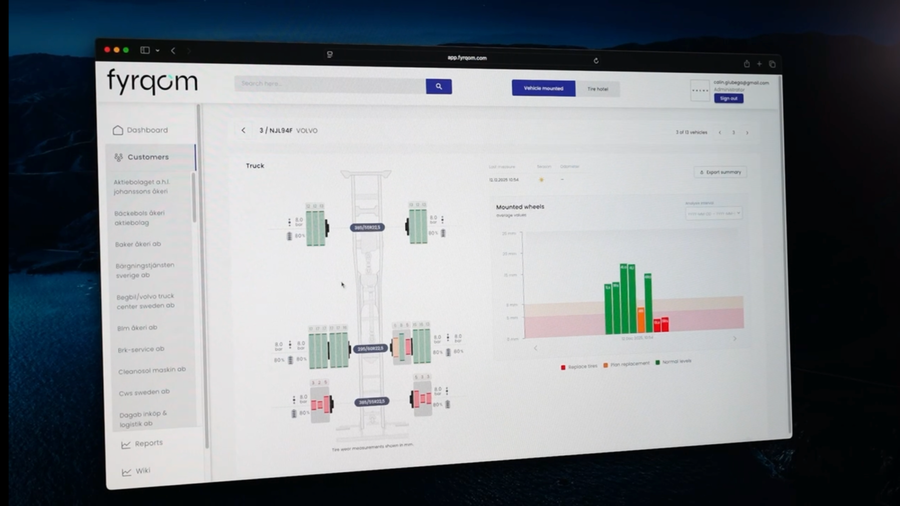

In an interview with Tyre News Media, Fyrqom CEO Tin Avdagić argued that the next challenge in connected tyre technology is not collecting more information, but making that information easier to use. For fleets and workshops, he says digital tyre management has to remove work, support clearer decisions and fit naturally into existing operations.
.jpeg)
.png)
When Tyre News Media spoke to Fyrqom CEO Tin Avdagić about the growing volume of data available from tyres, his starting point was simple: more information is not automatically more useful.
“The real challenge is turning data into better decisions,” he told TNM.
The conversation followed TNM’s Beyond Pressure: When Tyre Condition Becomes Data, which examined research into richer tyre-condition monitoring and asked whether increasingly sophisticated sensing can translate into better maintenance decisions.
Avdagić’s view is that the commercial test comes later, when that information reaches the people expected to act on it.
He argues that fleets, workshops and tyre service providers are ultimately interested in operational outcomes rather than the quantity of data produced. Fewer unplanned stops, reduced manual work, better planning and healthier margins are among the benefits he believes digital systems need to support if their additional data is to justify its place in day-to-day operations.
That thinking is closely tied to Fyrqom’s own origins.
Volvo Group, Qamcom Group and Volvo engineer Roman Iustin formed Fyrqom in 2022 around a system designed to automate TPMS calibration on heavy-duty vehicles. Volvo said at the time that calibration was being carried out manually during vehicle production and following tyre changes in workshops, while Iustin’s system had been developed to make that process more efficient.
Fyrqom has since extended its work into areas including RFID, tyre identity and tread measurement. Avdagić told TNM that, despite that expansion, the underlying objective has remained much the same: collect useful tyre information without creating another task for the technician or fleet operator.
Part of that ambition, he said, is to make tyre inspections sufficiently simple and fast that measurement happens routinely rather than only when a specific problem is already suspected.
For Fyrqom, reducing friction therefore goes beyond shortening an individual inspection. Avdagić argues that if condition measurement becomes easy enough to form part of normal workshop or fleet activity, operators can build a more consistent history of each tyre, identify emerging issues earlier and spot service requirements that might otherwise be missed.
Asked which tyre-health information fleets and tyre businesses actually need, Avdagić pointed to tread depth, tyre pressure, tyre identity, vehicle identity and inspection history as information capable of answering many routine operational questions, provided it is reliable and collected consistently.
His argument is not that systems should necessarily collect fewer data points. Automated systems can gather substantial amounts of information without increasing the burden on the user.
The distinction, he says, is between what a system collects and what the person using it should have to interpret.
“Our philosophy is to remove work instead of adding it,” Avdagić said.
For Fyrqom, that means processing the available information so that the exceptions requiring attention become obvious rather than expecting users to search through measurements, graphs or dashboards. Avdagić points to questions such as which vehicle should be prioritised, which tyre is approaching replacement and how soon an intervention is likely to be required.
That approach also informs his view of where commercial, safety and sustainability considerations can overlap.
Avdagić argues that better condition information can identify service opportunities and support maintenance planning while helping fleets make more informed decisions about how long a tyre can safely remain in use. He also sees potential for better data to support decisions around reuse and retreading, particularly for heavy vehicle tyres capable of multiple lifecycles.
In that sense, he believes there can be a shared interest in extracting greater safe use and value from each tyre relative to the materials and energy involved in producing it. Those outcomes depend on how the technology is implemented and used, rather than following automatically from collecting more data.
During the interview, Avdagić also pointed to a recent Volvo workshop pilot as an example of what Fyrqom’s approach can look like in practice.
According to Fyrqom, three technicians inspected approximately 100 heavy vehicles in around one hour, with information documented automatically, synchronised to the cloud and vehicle reports available immediately.
Avdagić said the benefit was not simply inspection speed, but the immediate availability of structured information in place of handwritten records.
The discussion is becoming increasingly relevant as Fyrqom explores how its tyre information can be combined with other vehicle data.
On 10 September, NIRA Dynamics and Fyrqom announced an exploratory collaboration examining how vehicle signals, tyre sensing and digital services could be brought together for trucks and commercial vehicle fleets. The companies said one area of interest is converting information generated by individual vehicles into fleet-level intelligence supporting maintenance planning, vehicle availability and tyre management. The work remains exploratory and does not itself demonstrate commercial outcomes.
Digital tyre identity is also developing against a changing regulatory backdrop. Avdagić says Fyrqom is preparing for the EU’s Ecodesign for Sustainable Products Regulation and Digital Product Passport framework. The European Commission currently indicates Q3-Q4 2027 for adoption of tyre-specific ESPR/DPP requirements, while the central DPP Registry became operational in July 2026.
For Avdagić, however, regulation and sensing capability do not remove the practical adoption problem.
“I actually don’t think technology is the biggest barrier anymore,” he told TNM. “Simplicity is.”
His argument is that digital tyre management will become routine when data collection fits naturally into existing work and the resulting information makes the next action clear without extensive training or interpretation.
That is not yet an industry-wide conclusion. But it provides a useful test for increasingly sophisticated tyre technology: not simply what a system can measure, but whether it removes enough friction from an existing decision to make people use it.
Fyrqom is a Swedish tyre technology company focused on digital tyre intelligence and practical tools for tyre operations. Its technology covers areas including digital tread measurement, tyre identity, TPMS and the connection of tyre-health information with existing workshop and fleet workflows.
Website: Fyrqom.com
Tags: Fyrqom, Tin Avdagić, tyre data, smart tyres, connected tyres, fleet tyre management, digital tyre management, TPMS, tyre RFID, tyre inspections, NIRA Dynamics, Digital Product Passport
Editorial Standards & Disclaimer
Tyre News Media is an independent industry publication. Our reporting is based on information available at the time of publication, including company announcements, regulatory filings, official data, research and other sources considered reliable.
Articles may include independent analysis and editorial interpretation. Where appropriate, company statements and third-party claims are attributed to their source. Analysis, estimates and forward-looking observations should not be read as statements of established fact.
Tyre News Media takes reasonable steps to ensure accuracy but welcomes corrections, clarifications and responses from organisations or individuals covered in our reporting. If you believe information is inaccurate or requires clarification, please contact info@tyrenews.co.uk. Material errors will be corrected as appropriate.
Commercial relationships, advertising and sponsorship do not determine Tyre News Media's editorial coverage or conclusions.


_0%20(1).png)












.png)

%20(1).jpeg)

.jpg)


%20(1).jpeg)