
A visit to Yokohama TWS’s agricultural tyre plant in Tivoli has highlighted a potentially important shift in farm tyre technology. VF construction, connected sensors and central tyre inflation systems are increasingly addressing different parts of the same problem: keeping agricultural machinery at an appropriate inflation pressure as operating conditions change. The commercial question is whether those technologies can now deliver a measurable whole-life return.
The agricultural tyre has traditionally been specified around familiar variables: machine weight, load, speed, application, traction and durability. Increasingly, however, premium tyre technology is addressing another question. Rather than simply engineering a tyre capable of performing across different conditions, can the tractor manage that tyre more intelligently while it works?
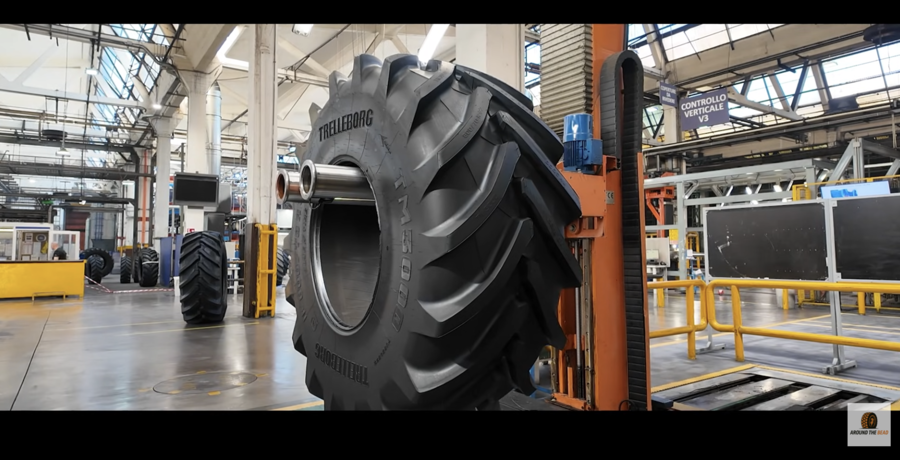
That question emerged during a recent Around The Bead Podcast visit to Yokohama TWS’s Tivoli plant in Italy, the historic home of Trelleborg agricultural tyre production. The factory tour follows the manufacturing process from mixing and materials testing through tyre building, curing, inspection and destructive testing, while also examining automation, competitor benchmarking and technology development. Among the subjects explored are tyre sensors capable of communicating with central tyre inflation systems (CTIS), tyres for electric tractors and the growing use of sustainability-driven materials.
The significance lies less in any one technology than in what happens when several are brought together. Very High Flexion (VF) construction provides a wider range of inflation possibilities, sensors provide information about the tyre's operating conditions and CTIS provides a means of changing inflation pressure as the tractor moves between tasks. Greater vehicle connectivity potentially provides the architecture through which those elements can increasingly interact.
The advantages of IF and VF agricultural tyres are well established. Their construction enables specified loads to be carried at lower inflation pressures than conventional radial tyres, allowing a larger footprint that can help reduce pressure on the soil.
But there is an important distinction between owning a tyre capable of operating at lower pressure and ensuring it is operating at the appropriate pressure throughout the machine's working cycle.
Agricultural tractors routinely move between environments with very different requirements. Lower inflation pressures can increase the contact area in field operations, supporting traction and reducing soil pressure, while road travel can require higher pressures as speed, load and operating conditions change.
That makes pressure management increasingly important to extracting the value already engineered into a VF tyre. Tyre News Media has previously reported on Trelleborg VF tyre pressure optimisation during field and road demonstrations, while another UK example paired Michelin AxioBib 2 VF tyres with Fendt's VarioGrip CTIS to enable pressure adjustment between field and road use.
The progression from VF alone towards VF combined with CTIS is therefore commercially significant. Instead of inflation pressure being something periodically checked and manually adjusted by an operator, it becomes a variable that can be managed as part of the operation of the machine.
Connected tyre technology adds another layer.
Trelleborg's Adaptive Tire Management System (ATMS) uses tyre-mounted sensors to detect working conditions including dynamic load, pressure and temperature. According to Yokohama TWS, the system uses that information to advise operators on appropriate inflation pressure, tractor ballast and implement set-up.
That distinction is important. ATMS already demonstrates the ability to collect tyre information and turn it into recommendations for tractor configuration. The Tivoli factory programme goes further in highlighting sensor technology capable of communicating with CTIS, pointing towards closer integration between tyre intelligence and inflation hardware.
The commercial significance would increase considerably if information generated at the tyre can increasingly inform systems capable of adjusting how the tyre operates. In principle, that creates the foundations for a feedback loop between tyre, tractor and inflation system.
This is where the definition of the product begins to change. The tyre remains a mechanical component whose carcass, compound and tread design determine its fundamental capabilities, but it also becomes a source of operating information within a wider vehicle system.
That direction is already visible in the relationship between tyre and tractor technology. Tyre News Media's previous coverage of Trelleborg VF tyres working with Valtra's factory-fitted CTIS showed how tyre specification and inflation hardware can increasingly be treated as a combined machine set-up rather than independent purchasing decisions.
For farmers and contractors, technological sophistication is not in itself a business case. The more important question is whether better tyre management generates sufficient operational value to justify additional equipment, integration and complexity.
Agricultural tyre economics extend considerably beyond purchase price. Fuel or energy consumption, tyre wear, machine productivity, traction and soil compaction can all affect the real cost of operating machinery. Pressure management potentially touches several of those variables simultaneously.
This creates an interesting challenge for premium tyre manufacturers. Demonstrating that a VF tyre can carry a specified load at a particular inflation pressure is relatively straightforward. Establishing the financial return from combining premium tyres, sensors and inflation equipment across real-world operating cycles is considerably more demanding.
It may also become an increasingly important competitive battleground.
If connected tyres and CTIS enable machinery to spend more of its working life at pressures appropriate to its actual operating conditions, premium agricultural tyres can potentially be sold as part of an efficiency system rather than principally on durability, traction or soil protection.
The argument could be particularly relevant to agricultural contractors and larger fleets, where modest improvements repeated across multiple machines and operating hours can accumulate. But that also raises the evidential standard. Manufacturers and technology suppliers will increasingly need operational data capable of showing customers where the return comes from and under what conditions it can realistically be achieved.
Electric tractors introduce another variable into that equation.
Trelleborg developed its TM1 ECO POWER with Fendt specifically for the e107 Vario electric tractor. Yokohama TWS says the tyre was designed with performance and energy efficiency in mind, including low rolling resistance, while ATMS was presented alongside it as part of the company's smart-farming technology portfolio.
The manufacturer's claims about rolling resistance and battery benefits should be treated as such, but the underlying engineering question is important. On battery-electric machinery, energy lost through unnecessary resistance ultimately consumes energy stored onboard the vehicle. Tyre optimisation therefore potentially becomes part of the range and productivity equation.
That does not necessarily mean electric tractors will create a completely separate agricultural tyre category. Agricultural tyres will still have to reconcile traction, durability, road behaviour, soil protection, load capacity and operating cost. Electrification does, however, increase the importance of another parameter: conserving available energy.
It also reinforces the case for closer tyre manufacturer involvement during vehicle development. The TM1 ECO POWER was developed with Fendt rather than simply offered as an aftermarket fitment, illustrating how tyre characteristics can become part of the engineering decisions surrounding the machine itself.
The implications extend beyond Yokohama TWS.
Agricultural tyre manufacturers remain fundamentally tyre engineering businesses, and compounds, carcass construction, tread geometry and manufacturing quality will continue to determine product performance. But the competitive environment is broadening to include sensors, data interpretation, inflation technology and vehicle integration.
That could gradually alter where differentiation is created. Manufacturers able to combine tyre engineering with useful operating data and effective integration with tractor systems may be able to demonstrate value that is harder to reproduce through the tyre alone.
The change also has implications for the aftermarket. Agricultural tyre dealers have traditionally competed through product knowledge, availability, fitting capability and emergency service. More sophisticated tyre-management systems potentially add diagnostics, configuration knowledge and technology support to that proposition.
Selling a premium agricultural tyre could consequently require a different conversation with the customer. Rather than explaining only why one tyre has superior traction, load capability or wear characteristics, suppliers may increasingly need to demonstrate how the tyre fits into a pressure-management strategy and what financial return that system can produce.
None of this makes the conventional agricultural tyre obsolete, nor does fitting a sensor automatically reduce operating costs. The value depends on whether the information generated leads to useful action and whether the resulting gains justify the cost and complexity of the technology.
The direction of development is nevertheless becoming clearer. VF construction expands the useful pressure envelope. Sensors provide information about what is happening at the tyre. CTIS provides the ability to alter pressure during operation. Vehicle connectivity creates the possibility of those technologies working more closely together, while electrification adds another reason to minimise avoidable energy losses.
The next stage of competition in premium agricultural tyres may therefore be about more than producing a tyre capable of carrying greater loads at lower pressures. The larger opportunity could be ensuring that the tractor knows how to make the best use of those capabilities throughout its working day.
At that point, the agricultural tyre starts to look less like a component fitted to the tractor and more like part of the machine's operating system.
Tags: agricultural tyres, smart tyres, VF tyres, CTIS, Yokohama TWS, Trelleborg tyres, tyre pressure management, connected tyres, electric tractors, farm tyres, agricultural machinery
Editorial Standards & Disclaimer
Tyre News Media is an independent industry publication. Our reporting is based on information available at the time of publication, including company announcements, regulatory filings, official data, research and other sources considered reliable.
Articles may include independent analysis and editorial interpretation. Where appropriate, company statements and third-party claims are attributed to their source. Analysis, estimates and forward-looking observations should not be read as statements of established fact.
Tyre News Media takes reasonable steps to ensure accuracy but welcomes corrections, clarifications and responses from organisations or individuals covered in our reporting. If you believe information is inaccurate or requires clarification, please contact info@tyrenews.co.uk. Material errors will be corrected as appropriate.
Commercial relationships, advertising and sponsorship do not determine Tyre News Media's editorial coverage or conclusions.
















%20(1).jpeg)