




Of an estimated 398 million newly fitted tyres brought into use on vehicles in the EU in 2024, 161 million were manufactured outside the bloc, according to an Oxford Economics study. Imports accounted for 40% of the total by volume and half of the tyres used on commercial vehicles.
The study, commissioned by Tyres Europe, estimates that the remaining 237 million tyres were manufactured in the EU. Its calculation includes tyres fitted to vehicles imported into the bloc and excludes EU-made tyres fitted to vehicles exported from it.
The import share differed considerably by tyre type. Oxford Economics estimates that imported tyres accounted for 31% of newly fitted tyres used on cars and 50% of those used on commercial vehicles. The figure was 87% for motorcycles and bicycles, and also 87% for the report’s other vehicles and equipment category. These are estimates based on tyre numbers, rather than their value.
The commercial-vehicle finding does not describe replacement sales alone. The report considers tyres supplied to vehicle manufacturers and replacement dealers, but does not provide a comparable breakdown of the import share for original equipment and replacement fitments.
The study identifies a second form of import reliance within EU tyre manufacturing. Imported intermediate inputs accounted for an estimated 11.9% of EU tyre production value in 2023, compared with an economy-wide EU figure of 7% for 2022. The EU is fully dependent on imports for natural rubber.
Tyres Europe is using the findings to argue that EU industrial policy should recognise the value of retaining advanced finished-tyre manufacturing capacity. Adam McCarthy, the association’s secretary general, said a strong EU production base would reduce reliance on external suppliers and help build a more resilient automotive value chain.
The figures distinguish two issues for policymakers: how much of the EU’s newly fitted tyre demand is supplied by manufacturers outside the bloc, and how much European factories depend on imported materials. Retaining production capacity in Europe would not remove the need to import natural rubber.
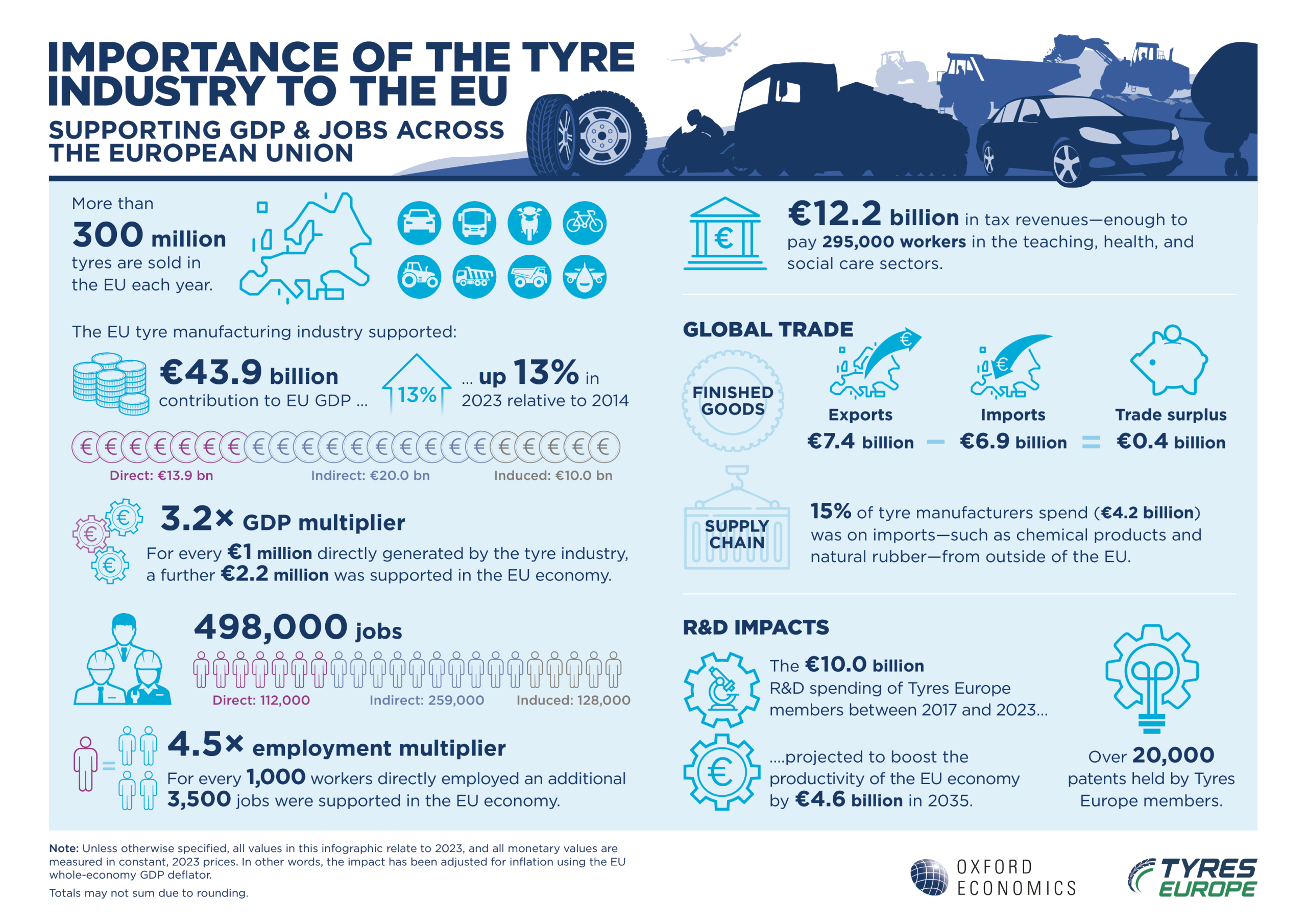
Oxford Economics also examines the scale of activities that depend on tyre-equipped vehicles and machinery. It reports that six major tyre-using sectors, including construction, agriculture and transport, directly generated €1.5 trillion in GDP and employed 30.5 million people in 2024. Those figures describe the sectors’ total direct economic activity. They are not an estimate of the contribution attributable to EU-made tyres.
In a separate calculation, the study estimates that EU-produced tyres potentially enabled €572 billion in GDP and 6.1 million jobs across the immediate customer sectors it models. Oxford Economics allocates a share of those sectors’ economic footprint using the volume share of EU-produced tyres. It cautions that the activity would not necessarily disappear if EU-produced tyres were unavailable.
The study also models a hypothetical disruption to natural rubber and tyre supply. That scenario examines possible effects under specified assumptions and is not a forecast.
Tyre News Media has asked Tyres Europe whether the import estimates can be broken down on a comparable basis between original-equipment and replacement fitments. This article will be updated if further detail becomes available.
Read the full Oxford Economics study via Tyres Europe.
Tags: EU tyre imports, commercial vehicle tyres, Oxford Economics, Tyres Europe, tyre manufacturing, tyre supply chain, newly fitted tyres, natural rubber, EU industrial policy, tyre market
Editorial Standards & Disclaimer
Tyre News Media is an independent industry publication. Our reporting is based on information available at the time of publication, including company announcements, regulatory filings, official data, research and other sources considered reliable.
Articles may include independent analysis and editorial interpretation. Where appropriate, company statements and third-party claims are attributed to their source. Analysis, estimates and forward-looking observations should not be read as statements of established fact.
Tyre News Media takes reasonable steps to ensure accuracy but welcomes corrections, clarifications and responses from organisations or individuals covered in our reporting. If you believe information is inaccurate or requires clarification, please contact info@tyrenews.co.uk. Material errors will be corrected as appropriate.
Commercial relationships, advertising and sponsorship do not determine Tyre News Media's editorial coverage or conclusions.

















%20(1).png)
%20(1).jpeg)