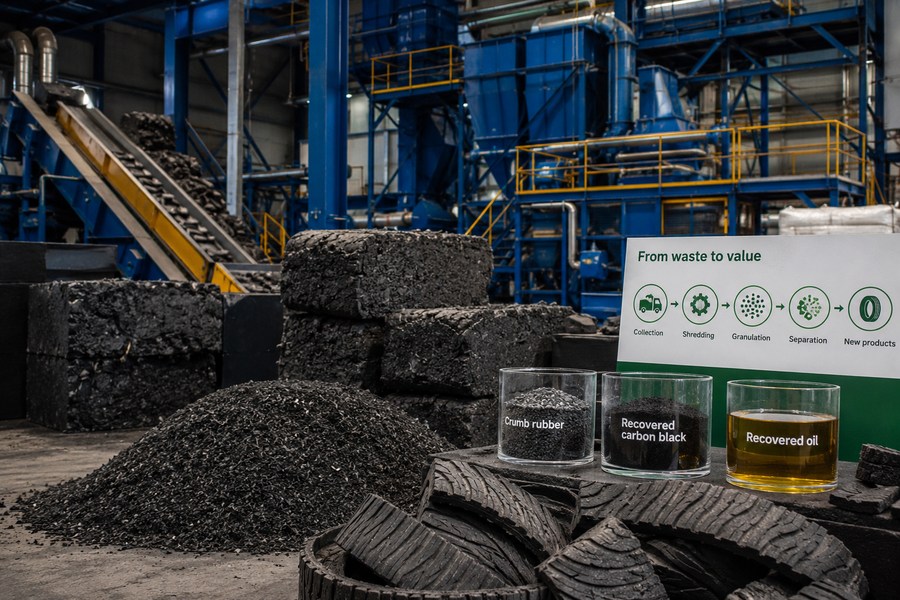

Europe’s tyre recycling market is entering a measured growth phase, with increasing attention turning from collection volumes to material quality. Market forecasts indicate steady expansion through 2030. However, the more significant development for tyre manufacturers is the growing use of recovered rubber, carbon black and tyre-derived oil as industrial raw materials.
Grand View Research estimates that Europe’s tyre recycling market generated revenue of USD 1.59 billion in 2024. It forecasts revenue of USD 1.95 billion by 2030, representing compound annual growth of 3.7% between 2025 and 2030.
The forecast does not indicate a sudden recycling boom. Instead, it points to a market supported by established collection networks, regulatory pressure and growing demand for secondary raw materials.
Europe represented 23.1% of global tyre recycling revenue during 2024, according to the research company. Rubber remained the region’s largest product category, accounting for 38.88% of revenue. Carbon black was identified as the fastest-growing segment.
For the tyre trade, this distinction matters. Growth based only on higher waste volumes would provide limited evidence of a stronger circular economy. Growth in materials suitable for reuse within manufacturing suggests greater commercial and technical progress.
Recovered carbon black is gaining particular attention because carbon black is a critical reinforcing ingredient in tyre compounds. Manufacturers require consistent particle properties, cleanliness and performance before introducing alternative grades into production.
Recent projects show that recovered materials are moving beyond low-value applications. Michelin has used recovered carbon black supplied by Scandinavian Enviro Systems in tyres developed for hydrogen and electric racing vehicles at Le Mans.
The tyres contained up to 63% sustainable materials. Enviro chief executive Thomas Sörensson said using its recovered carbon black in racing demonstrated the material’s “quality and capability”. Tyre News previously examined the Michelin and Enviro Le Mans application.
More recently, Longxing Technology Group reported an initial European order covering almost 10,000 tonnes of sustainable carbon black. The material uses oil recovered from waste tyres as a manufacturing feedstock.
The customer remains unnamed, and independent performance data has not been published. However, the order indicates that tyre-derived feedstocks are moving through manufacturer approval processes and towards commercial supply. Tyre News reported on Longxing’s first European carbon black order.
European recyclers still need sufficient processing capacity to manage the end-of-life tyre stream. Yet commercial success will increasingly depend on the quality and consistency of their outputs.
Recyclers seeking tyre-industry customers must deliver materials that perform reliably across different compounds and production sites. They must also provide traceability, certification and credible lifecycle data.
This requirement raises the technical and financial threshold for new projects. Producing fuel, aggregate or basic rubber granulate is different from supplying a reinforcing material suitable for new tyres.
The market therefore contains both opportunity and execution risk. Dutch recovered carbon black producer Black Bear Carbon filed for bankruptcy in 2025 after operational and financial difficulties following a factory fire. Its experience showed that strong demand projections do not remove the challenges of scaling specialised recycling processes.
At the same time, larger projects continue to attract investment. Bolder Industries secured €34 million for a proposed Antwerp facility designed to process more than six million end-of-life tyres annually. Operations are targeted for 2027.
The company intends to produce recovered carbon black and tyre-derived oil for tyres, rubber, plastics and other industrial uses. Tyre News examined the funding and proposed scale of Bolder Industries’ Antwerp plant.
The UK provides an additional growth angle for domestic tyre businesses. Grand View Research valued the UK tyre recycling market at USD 234.5 million in 2024. It forecasts revenue of USD 301.1 million by 2030.
That represents compound annual growth of 4.4%, compared with 3.7% across Europe. The researcher identifies the UK as Europe’s fastest-growing national market during the forecast period.
Rubber remained the UK’s largest revenue segment in 2024, with a 39.19% share. Carbon black was again identified as the fastest-growing category.
Forecasts should still be treated as directional rather than definitive. Market values can differ considerably depending on whether a report includes collection, mechanical recycling, pyrolysis, energy recovery or downstream material sales.
For tyre companies, the product mix may prove more useful than the headline market valuation. It shows where recyclers expect stronger demand and where manufacturers may find new sources of secondary materials.
Manufacturers face growing pressure to reduce dependence on virgin fossil-based inputs while maintaining tyre safety and performance. Higher-quality recovered materials could provide an additional sourcing route while supporting circularity targets.
For recyclers, the opportunity lies in moving beyond waste treatment. Better separation, material upgrading and stronger quality control can create outputs with higher margins and a wider customer base.
Wholesalers, retailers and fleet operators are less directly involved in raw-material procurement. However, greater use of recovered materials could strengthen environmental claims across the tyre supply chain. It may also affect future tender requirements and fleet purchasing policies.
Europe’s tyre recycling market is therefore growing in two ways. Its financial value is increasing steadily, while its strategic importance to tyre manufacturing is rising more quickly.
The next stage will not be judged solely by how many tyres are collected. It will depend on how much recovered material returns to productive use, at what quality and under what commercial terms.
Tagged with: European tyre recycling, end-of-life tyres, recovered carbon black, recycled rubber, tyre pyrolysis, circular raw materials, tyre-derived oil, ELT processing, sustainable tyre manufacturing, secondary raw materials, UK tyre recycling
Editorial Standards & Disclaimer
Tyre News Media is an independent industry publication. Our reporting is based on information available at the time of publication, including company announcements, regulatory filings, official data, research and other sources considered reliable.
Articles may include independent analysis and editorial interpretation. Where appropriate, company statements and third-party claims are attributed to their source. Analysis, estimates and forward-looking observations should not be read as statements of established fact.
Tyre News Media takes reasonable steps to ensure accuracy but welcomes corrections, clarifications and responses from organisations or individuals covered in our reporting. If you believe information is inaccurate or requires clarification, please contact info@tyrenews.co.uk. Material errors will be corrected as appropriate.
Commercial relationships, advertising and sponsorship do not determine Tyre News Media's editorial coverage or conclusions.


_0%20(1).png)












.png)
%20(1).jpg)
.jpeg)
.png)
%20(1).jpeg)
%20(1).jpeg)