Sailun, Triangle and Linglong reported sharply weaker third-quarter earnings as higher raw-material costs squeezed profitability, despite revenue growth at two of the three manufacturers.
Their disclosures show a shared increase in purchasing costs but different selling-price outcomes. Sailun and Triangle reported lower average tyre prices than a year earlier, while Linglong achieved an increase. The results offer three case studies of how costs, product mix and currencies are affecting Chinese tyre manufacturers, rather than a complete picture of the industry.
For European purchasing teams, the practical question is whether those pressures will translate into revised quotations or commercial terms, alongside changes in EU duty exposure. The earnings figures establish pressure on producers. They do not establish that suppliers are raising European prices, restricting credit or struggling to fulfil orders.
The comparison below covers July to September 2026. Percentage changes are year on year unless indicated otherwise.
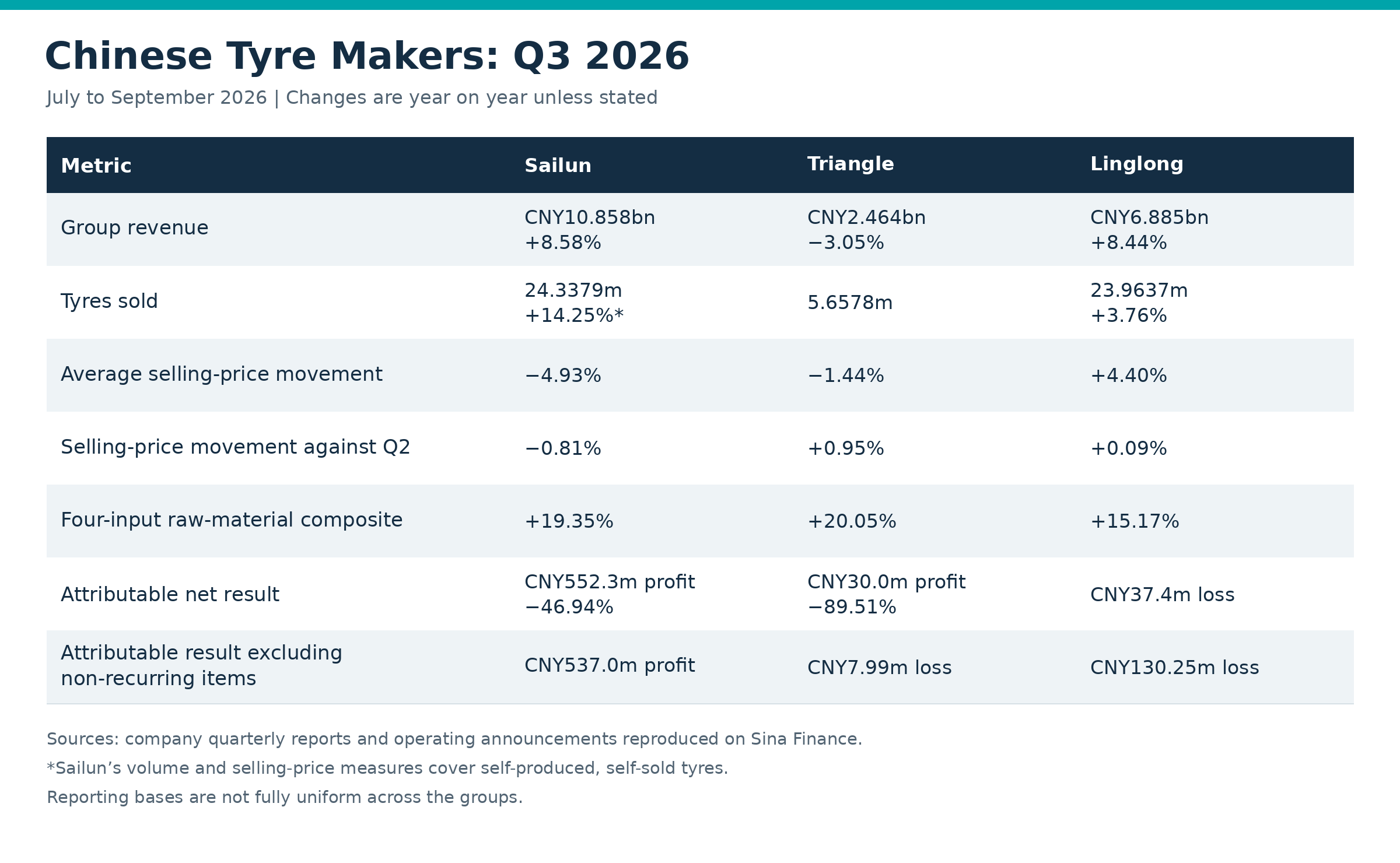
The clearest common pressure is the rise in the companies’ combined purchasing measures for natural rubber, synthetic rubber, carbon black and steel cord. These increased by between 15.17% and 20.05%.
Each composite reflects the manufacturer’s own purchasing mix. The figures therefore show the direction and scale of reported input pressure, rather than movements in an identical market-price index. They cannot be subtracted from selling-price changes to calculate margin erosion because the measures have different bases.
Sailun provides the clearest example of volume growth failing to protect quarterly earnings. Sales of self-produced tyres increased 14.25%, while group revenue rose 8.58%. Attributable net profit nevertheless fell 46.94%.
The company explicitly attributed weaker profitability to rapidly rising raw-material prices, a delay in passing those increases through to customers, and depreciation of the US dollar and other foreign currencies against the renminbi. Its average selling price also reflected changes in product structure.
Triangle reported a smaller business by quarterly revenue, with sales down 3.05% and attributable profit down 89.51%. Excluding non-recurring items, it recorded a CNY7.99m loss. Its report identified higher raw-material prices and the weaker dollar against the renminbi among the factors affecting earnings.
Triangle’s average selling price increased 0.95% against the second quarter but remained below the previous year. That sequential improvement alone does not establish when repricing began or whether individual European customers faced increases.
Linglong’s results show why the three manufacturers should not be described as following a single pricing pattern. Its average tyre selling price increased 4.40% year on year, reflecting changes in market and product structure. Sales volumes also grew, but the company reported a quarterly attributable loss.
Linglong attributed the Q3 deterioration principally to higher raw-material costs reducing gross profit. Separately, its nine-month explanation identified a currency swing that increased finance expenses by approximately CNY1.06bn compared with the previous year. That is a nine-month year-on-year effect, not a Q3 currency-loss figure.
Production costs and import duties affect different parts of the supply chain. A manufacturer’s group-wide earnings cover multiple products and markets. The EU measures concern a narrower category of Chinese-origin tyres.
Definitive EU anti-dumping duties of 4.3–45.3% apply to the relevant imports, depending on the producer and applicable conditions. The regulation was published on 7 July and took effect on 8 July 2026. Its scope covers new pneumatic rubber tyres for motor cars, buses or lorries with a load index not exceeding 121.
TNM’s latest subsidy-disclosure coverage explains reported proposed combined anti-dumping and countervailing rates of 27.50–57.09%. Those figures remain subject to a final decision and have not been independently verified by TNM against the original disclosure document.
The proposed combined range must not be added to the original anti-dumping rates. Buyers need the final treatment applicable to the relevant producer, including any adjustment to the anti-dumping component.
EU measures do not automatically apply to UK imports. Businesses supplying both markets must assess the two trade-remedies systems separately.
TNM’s analysis is that purchasing teams need to separate three variables: the supplier’s quoted price, the applicable customs treatment and the terms supporting delivery.
Cost pressure gives manufacturers a reason to seek better price recovery. It does not establish that an increase will be requested, accepted or applied equally across products and markets. Current quotations for comparable fitments, volumes and delivery terms are needed to test that possibility.
The same distinction applies to credit. Deposits, payment periods and credit limits are worth checking during contract discussions, but these results do not demonstrate that any of the three manufacturers has tightened customer terms.
Sourcing comparisons also need to identify the manufacturing origin and relevant producing entity. A brand’s nationality alone does not determine whether a shipment falls within measures targeting Chinese-origin goods.
For buyers considering another supplier, the comparison should include fitment availability, lead times, approvals where relevant and the cost of changing stock ranges. A lower headline quotation may offer limited value if it leaves gaps in the sizes customers require.
The next indicators to watch are confirmed quotation changes, subsequent input-cost movements, selling-price trends and the EU’s final subsidy decision. Any assessment of supplier resilience also requires cash flow, liquidity and debt analysis. Quarterly profit alone cannot establish delivery risk.
Tags: Chinese tyre manufacturers, Q3 2026 results, Sailun, Triangle Tyre, Linglong, tyre raw-material costs, tyre pricing, EU tyre duties, European tyre sourcing, tyre procurement
Editorial Standards & Disclaimer
Tyre News Media is an independent industry publication. Our reporting is based on information available at the time of publication, including company announcements, regulatory filings, official data, research and other sources considered reliable.
Articles may include independent analysis and editorial interpretation. Where appropriate, company statements and third-party claims are attributed to their source. Analysis, estimates and forward-looking observations should not be read as statements of established fact.
Tyre News Media takes reasonable steps to ensure accuracy but welcomes corrections, clarifications and responses from organisations or individuals covered in our reporting. If you believe information is inaccurate or requires clarification, please contact info@tyrenews.co.uk. Material errors will be corrected as appropriate.
Commercial relationships, advertising and sponsorship do not determine Tyre News Media's editorial coverage or conclusions.