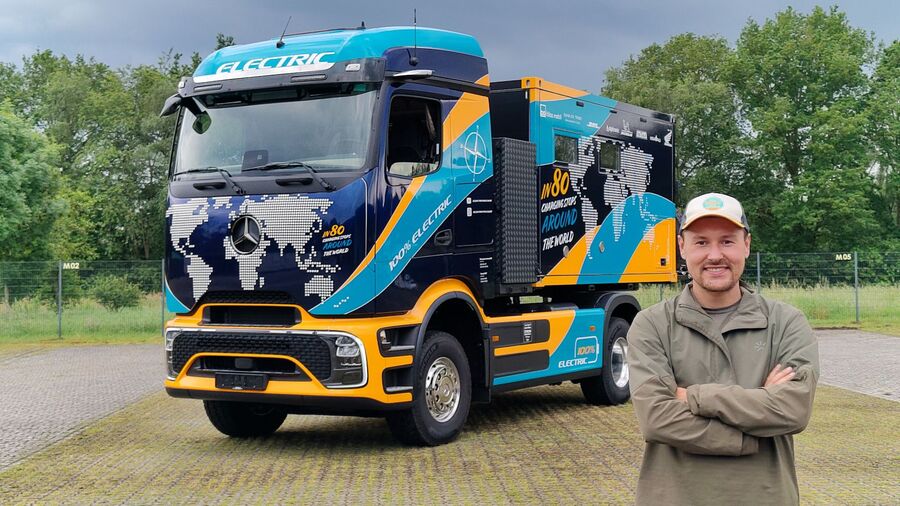

Tobias Wagner will leave IAA Transportation in Hanover on 20 September in a specially converted Mercedes-Benz eActros 600, beginning a planned 45,000 km journey across five continents. The expedition vehicle is fitted front and rear with Michelin X Works HL Z2 tyres in 385/65 R22.5, selected to balance road efficiency with traction and durability away from paved surfaces.
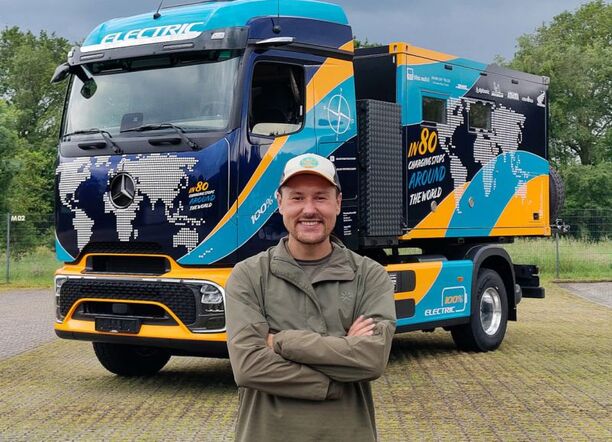
Professional truck driver and content creator Tobias Wagner, known online as Elektrotrucker, is preparing to depart IAA Transportation in Hanover on 20 September for an approximately year-long electric truck expedition.
Mercedes-Benz Trucks says the planned route will cover around 45,000 kilometres through about 30 countries on five continents, with fewer than 80 charging stops. Wagner will drive a specially converted Mercedes-Benz eActros 600 based on the series-production 4x2 platform.
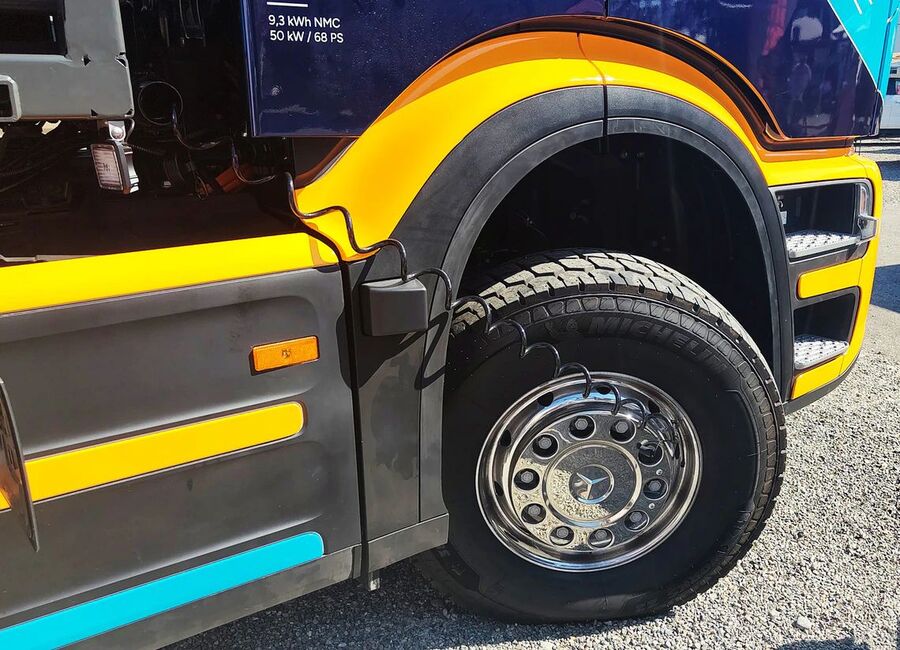
For the tyre equipment, Michelin has supplied its X Works HL Z2 in size 385/65 R22.5. The same tyre dimension is fitted at the front and rear, using wide single tyres rather than a conventional heavy truck drive-axle twin arrangement.
That configuration is closely linked to the unusually low operating weight of the expedition vehicle. Michelin puts its ready-to-travel weight at 16.5 tonnes, substantially below the gross combination weights encountered by an eActros 600 in normal long-haul freight operation.
Tyre choice creates a particular compromise for an electric vehicle attempting such a varied journey. Lower rolling resistance can reduce energy consumption, but Wagner's route is also expected to include gravel, poor roads and unmade surfaces where traction, casing protection and ground clearance become more important.
Michelin says an optimised road tyre was initially considered because it would have offered the best opportunity to maximise range. The X Works HL Z2 was chosen instead because the journey requires greater mixed-surface capability.
The 385/65 R22.5 X Works HL Z2 is an all-position product designed for road use and access to construction sites and quarries. Michelin lists it with a 164 single-fitment load index, 3PMSF and M+S markings and a maximum single-fitment axle load of 10 tonnes. It is also listed as compatible with electric vehicles.
On the expedition truck, tyre pressure can be reduced through a central pressure system when operating on softer surfaces, increasing the contact area, before being raised again for paved roads using the vehicle's compressed-air system. The larger tyre diameter also provides additional ground clearance.
Using the same size at both axles gives Wagner another practical advantage: tyres can be repositioned if necessary following a puncture or other problem. The truck also carries two spare-wheel carriers as part of its expedition conversion.
The project could provide useful real-world observations on how a mixed-service commercial tyre behaves across unusually varied climates, surfaces and operating conditions. Factors including tyre pressure, tread wear and any changes in tyre position during the journey would make particularly useful data if they are recorded consistently.
The tyre challenge sits alongside an equally unusual charging strategy. The eActros 600 has 621 kWh of installed battery capacity, while the expedition vehicle also carries an Alpitronic DC charging unit. Mercedes-Benz Trucks says this allows Wagner to use suitable AC supplies at up to 43 kW where conventional high-power truck charging is unavailable.
Mercedes-Benz Trucks describes the journey, to its current knowledge, as the first planned circumnavigation of the globe by a fully battery-electric truck. Whether the tyres last the complete distance on one set will only become clear as the expedition progresses.
In 80 Stops Around the Word Trailer - Credit | Daimler Truck
Tags: Michelin X Works HL Z2, Tobias Wagner, Elektrotrucker, Mercedes-Benz eActros 600, electric truck tyres, truck tyres, 385/65 R22.5, electric trucks, IAA Transportation, commercial vehicle tyres
Editorial Standards & Disclaimer
Tyre News Media is an independent industry publication. Our reporting is based on information available at the time of publication, including company announcements, regulatory filings, official data, research and other sources considered reliable.
Articles may include independent analysis and editorial interpretation. Where appropriate, company statements and third-party claims are attributed to their source. Analysis, estimates and forward-looking observations should not be read as statements of established fact.
Tyre News Media takes reasonable steps to ensure accuracy but welcomes corrections, clarifications and responses from organisations or individuals covered in our reporting. If you believe information is inaccurate or requires clarification, please contact info@tyrenews.co.uk. Material errors will be corrected as appropriate.
Commercial relationships, advertising and sponsorship do not determine Tyre News Media's editorial coverage or conclusions.

_0%20(1).png)












.png)
%20(1).jpg)
.jpeg)
.png)
%20(1).jpeg)
%20(1).jpeg)