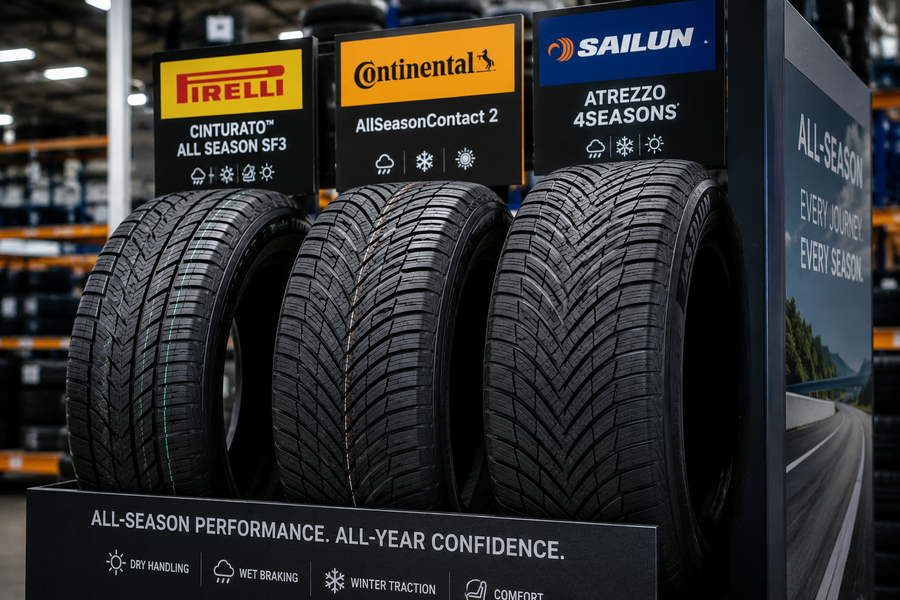

Growing interest in all-season tyres is giving UK distributors, retailers and fleet operators a broader product range to consider. Buyers can now compare premium benchmarks such as Pirelli’s Cinturato All Season SF 3 with Continental’s balanced offering and Sailun’s value-focused Atrezzo 4Seasons Ultra.
All-season tyres were once treated as a narrow alternative to separate summer and winter fitments. The category now carries greater commercial importance across the UK and European replacement markets.
Manufacturers are introducing products for a wider range of vehicles, driving styles and budgets. Independent tyre tests are also assessing larger and more varied product fields.
For distributors and retailers, this creates more opportunities to match tyres with customer expectations. It also increases the need for clear advice about braking, handling, wear, noise and winter capability.
The category is not simply about weather convenience. It can support motorists who do not want seasonal tyre changes while giving retailers another structured replacement option.
.jpg)
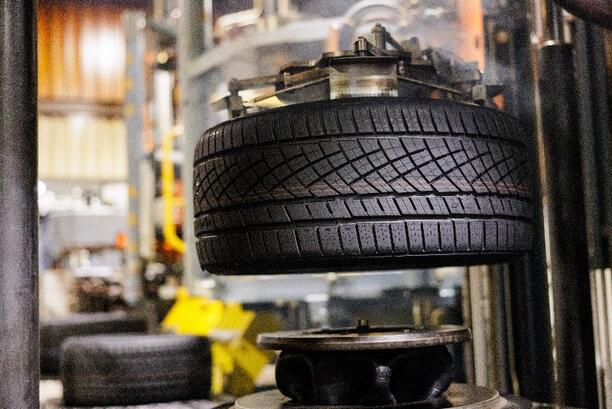
Pirelli’s Cinturato All Season SF 3 provides a strong reference at the premium end of the market. Independent test coverage has placed it among the category’s strongest products across dry, wet and winter assessments.
Its performance demonstrates how far premium all-season tyres have developed. Buyers increasingly expect these products to perform confidently in warm conditions without losing useful cold-weather capability.
That development changes the retail conversation. Premium all-season tyres are no longer sold solely as convenient compromises. They must now demonstrate measurable braking, handling and aquaplaning performance across varied conditions.
.jpeg)
Continental’s AllSeasonContact 2 strengthens the premium and upper-mid-market choice available to tyre buyers.
Independent comparisons have highlighted its balanced behaviour across dry, wet and winter surfaces. Comfort, predictable handling and year-round usability are also central to its proposition.
That balance may appeal to drivers who value consistency rather than one class-leading result. It also gives retailers a recognised alternative when application, vehicle type or product availability rules out another premium option.
Continental’s position illustrates the depth now found within the category. Buyers can compare several established products rather than choosing between one premium tyre and a group of largely undifferentiated alternatives.
%20(1).jpeg)
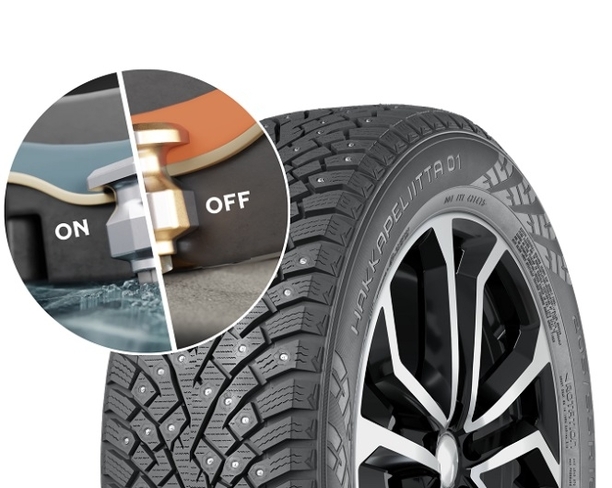
Sailun’s Atrezzo 4Seasons Ultra brings a lower-cost proposition into the comparison. The product is intended to balance wet, dry and winter performance for European motorists seeking year-round usability.
Test coverage suggests it can provide competent everyday performance, particularly for buyers prioritising affordability and running costs. However, it does not consistently match the sharper braking and handling performance recorded by the strongest premium products.
That distinction is commercially important. The Sailun should not be positioned as an equivalent replacement for every premium tyre. It instead broadens the category for customers willing to accept measurable compromises at a lower price point.
Sailun has continued to build its European product presence, including recent activity around its winter range. Tyre News previously reported on Sailun’s cold-weather tyre trials in Finnish Lapland, where the company presented new products in snow, ice, slush and wet-road conditions.
Individual tyre-test outcomes depend on tyre size, vehicle, temperature, surface and assessment method. A strong result in one comparison should not be presented as universal proof of performance.
The available evidence still shows meaningful differences between products. Pirelli provides a strong performance benchmark. Continental offers a balanced premium alternative, while Sailun adds a more accessible value proposition.
This creates a useful sales conversation for tyre retailers. Customers can be shown where higher prices deliver measurable benefits and where less expensive products remain suitable for less demanding use.
Retailers should also avoid reducing the comparison to brand or price alone. Vehicle type, annual mileage, local weather and expected use should remain central to any recommendation.
The growth of all-season products gives wholesalers and retailers scope to build clearer good-better-best ranges. It may also help businesses serve motorists who previously kept summer tyres fitted throughout the year.
Recent launches suggest manufacturers expect the category to continue expanding. Tyre News reported that Yokohama introduced the BluEarth-AllSeason2 for European cars, SUVs and electric vehicles.
The product launch reflects increasing demand for all-season tyres designed around a wider mix of conventional and electrified vehicles.
The ultra-high-performance end of the category is expanding as well. Apollo Tyres plans to introduce the Vredestein Quatrac Pro 2 all-season tyre during summer 2026.
The Quatrac Pro 2 is intended for modern performance vehicles, including hybrid and battery-electric models. Its development points to increasing segmentation within the wider all-season market.
Fleet adoption provides another indication of the category’s relevance. British Gas has specified Michelin Agilis CrossClimate products for 2,500 vans under a major vehicle renewal programme.
Tyre News reported that the British Gas fleet will use Michelin all-season tyres to support year-round mobility. The operator also linked the fitment to reduced downtime from avoiding seasonal tyre changes.
The commercial opportunity therefore extends beyond one manufacturer or price point. All-season demand is creating a wider market in which safety evidence, application and customer budget must be considered together.
The comparison between Pirelli, Continental and Sailun reflects a broader change in the market. All-season products now span premium performance, balanced established options and value-focused alternatives.
Pirelli sets a demanding reference for drivers prioritising braking and dynamic performance. Continental provides a rounded alternative, while Sailun extends the category to more price-conscious customers.
For wholesalers, this can support broader stock planning and clearer product segmentation. Retailers can also use the differences to explain why tyres carrying the same all-season description may perform differently.
The rise of all-season tyres is therefore about more than weather convenience. It is creating a larger and more commercially relevant category across retail, wholesale and fleet channels.
Tagged with: all-season tyres, UK tyre market, Pirelli Cinturato All Season SF 3, Continental AllSeasonContact 2, Sailun Atrezzo 4Seasons Ultra, wet braking, winter performance, tyre retail, tyre wholesale, fleet tyres, replacement tyre market
Editorial Standards & Disclaimer
Tyre News Media is an independent industry publication. Our reporting is based on information available at the time of publication, including company announcements, regulatory filings, official data, research and other sources considered reliable.
Articles may include independent analysis and editorial interpretation. Where appropriate, company statements and third-party claims are attributed to their source. Analysis, estimates and forward-looking observations should not be read as statements of established fact.
Tyre News Media takes reasonable steps to ensure accuracy but welcomes corrections, clarifications and responses from organisations or individuals covered in our reporting. If you believe information is inaccurate or requires clarification, please contact info@tyrenews.co.uk. Material errors will be corrected as appropriate.
Commercial relationships, advertising and sponsorship do not determine Tyre News Media's editorial coverage or conclusions.

_0%20(1).png)













%20(1).jpeg)