
The tyre industry’s search for an alternative to 6PPD is moving into a deeper phase, with manufacturers examining a wider field of candidate antidegradants ahead of California’s final Alternatives Analysis process. The regulatory timetable now extends to 2029, giving manufacturers more development time but underlining the scale of the technical, supply-chain and product-validation challenge.
Replacing 6PPD is increasingly looking less like a conventional chemical substitution and more like a multi-year tyre development programme.
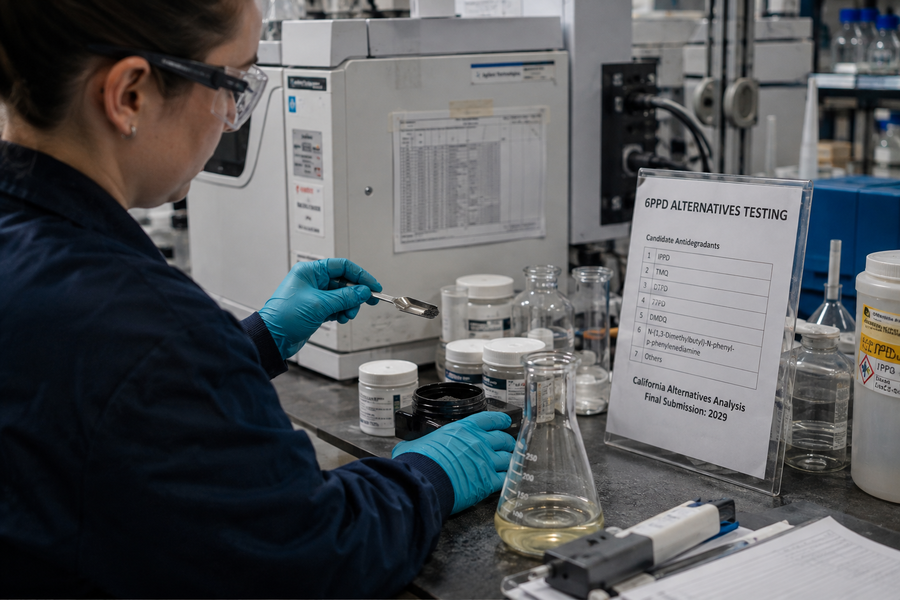
The U.S. Tire Manufacturers Association’s 6PPD Alternatives Analysis Consortium has moved beyond the seven candidates identified in its preliminary work and is evaluating a broader working set as new toxicity, performance and supplier information becomes available.
That expansion is significant. It shows that the industry has not reached the point of choosing a replacement chemistry. Instead, manufacturers are still trying to establish whether any candidate can combine a better environmental profile with the durability, safety, manufacturability and economics demanded of a tyre antidegradant.
The regulatory timetable also gives that work a longer horizon than previously envisaged. USTMA now says the consortium’s Stage 2 Alternatives Analysis report is due to California’s Department of Toxic Substances Control (DTSC) on 1 October 2029, with annual progress reporting in the meantime.
For tyre manufacturers, the extra time does not make the problem smaller. It makes clearer what is likely to be required if a credible substitute emerges.
6PPD performs a critical function in tyre compounds, protecting rubber against degradation caused by ozone, oxygen, heat and repeated flexing. Its effectiveness is one reason replacing it is technically difficult.
The preliminary Alternatives Analysis examined more than 60 possible substitutes, with seven initially advanced for further consideration: 7PPD, IPPD, 77PD, CCPD, specialised graphene, octyl gallate and Irganox 1520.
That shortlist was never equivalent to seven commercially viable replacements. It identified materials considered sufficiently promising to warrant deeper investigation.
The search has subsequently widened.
USTMA said during the Stage 2 work that supplier engagement, new toxicity information and additional industry data had resulted in an expanded working set of 24 candidates, including those identified during Stage 1. California DTSC has separately reported that tyre manufacturers collectively selected 21 alternative antidegradants for more detailed evaluation across their Alternatives Analyses.
The distinction matters because different manufacturers and groups are not necessarily following an identical candidate list. DTSC says 75 tyre manufacturers notified the agency that they sell tyres containing 6PPD in California, while consortium members account for more than 90% of the Californian tyre market.
The regulatory process is therefore encouraging a broad technology search rather than prescribing a single substitute.
Some candidates remain chemically related to 6PPD. Others involve substantially different approaches, including emerging graphene and bio-based technologies.
That creates an uncomfortable engineering trade-off. A chemically similar antidegradant may be easier to integrate into existing compounds but could retain environmental characteristics regulators want to avoid. A more fundamentally different chemistry could offer a better environmental outcome while creating greater uncertainty around tyre performance and industrial processing.
The central commercial issue is validation.
Even if laboratory testing identifies a material with promising ozone resistance and a more favourable toxicity profile, that does not establish that it can replace 6PPD across a manufacturer’s product range.
Tyres contain multiple interacting rubber compounds. Tread, sidewall, innerliner, carcass, belt skim and bead formulations perform different functions and can respond differently to changes in antidegradant chemistry.
Requirements also vary between passenger-car, light commercial, truck, bus, winter, high-performance, run-flat and specialist applications.
The consequence is that manufacturers are unlikely to validate a successful candidate once and simply deploy it across every tyre.
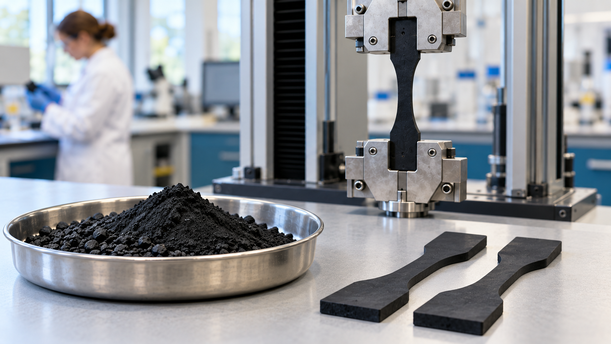
A potential replacement would first need to be assessed within affected compound families. Engineers would have to establish appropriate dosage and dispersion, check interactions with other ingredients, confirm cure behaviour and assess static and dynamic ozone resistance.
Representative tyres would then need to move through endurance, high-speed, rolling-resistance, wear, traction and vehicle testing before commercial introduction.
Original-equipment programmes add another layer. Where a changed compound affects an approved tyre specification, manufacturers may need to demonstrate to vehicle makers that the revised product continues to meet programme requirements.
The industry therefore faces an important distinction between chemical feasibility and industrial feasibility.
A substance may be capable of replacing 6PPD in a laboratory compound without being capable of replacing it economically across a global tyre portfolio.
That challenge mirrors a wider issue facing manufacturers as they increase renewable and recycled content. As Tyre News Media reported in its coverage of Linglong’s 85% sustainable concept tyre, alternative materials ultimately have to meet the same safety, efficiency and performance demands as established formulations.
A successful replacement would not necessarily require wholesale replacement of tyre manufacturing equipment.
The most straightforward outcome would be a material that can use existing storage, dosing and mixing infrastructure and be incorporated without fundamentally changing curing or downstream production.
But even a relatively compatible substitute could create process changes.
Different physical form, particle characteristics, melting behaviour or handling requirements could require modified storage and dosing arrangements. Mixing sequence, temperature, cycle time and energy input could also need adjustment.
Workplace controls may change if the substitute creates different dust, exposure or ventilation requirements, while a material that interacts differently with vulcanisation chemistry could force changes elsewhere in the compound.
The implications become greater for non-PPD technologies that rely on a different mechanism of protection.
The industry's development activity is already moving beyond conventional antidegradant chemistry. Alternative 6PPD technology was among the chemicals and compounding developments highlighted in Tyre News Media’s 2026 Tire Technology International Awards coverage, illustrating how the regulatory issue is beginning to influence the commercial innovation pipeline.
A technically successful alternative would also create a major upstream qualification exercise.
Tyre manufacturers consume raw materials at industrial scale and expect tightly controlled specifications across factories and regions. A promising antidegradant therefore has to move from laboratory availability to dependable global production.
Manufacturers will need to understand who controls the chemistry, where it can be produced, how rapidly capacity can expand and whether multiple qualified suppliers can eventually support it.
Batch consistency, regulatory registrations, transport requirements, intellectual property and long-term pricing will all influence the commercial decision.
This creates a potential bottleneck.
If several large manufacturers converge on the same candidate, demand could rise rapidly before chemical suppliers have installed sufficient capacity. A technically preferred alternative supplied by only one producer would also create concentration risk for an ingredient that directly affects tyre durability.
Chemical companies face the opposite problem. Investing in substantial new production capacity is difficult while toxicity work, tyre testing and regulatory assessment remain incomplete.
The 6PPD transition could therefore require closer collaboration between tyre manufacturers and their chemical suppliers long before any final substitution decision is made.
The burden will not be evenly distributed.
Large global manufacturers operate substantial compound-development laboratories and testing facilities and can spread validation costs across high production volumes. They also have greater leverage when securing raw-material supply.
Smaller and specialist manufacturers may have fewer products but can face disproportionately high qualification costs, particularly where production volumes are low or applications require niche compounds.
Their choices could include adopting chemistry already established elsewhere in the industry, outsourcing development work, rationalising affected products or maintaining regional formulations if California ultimately requires a solution that other markets do not.
That makes access to validated technology an important competitive question.
A replacement that requires extensive proprietary development could widen the capability gap between global manufacturers and smaller producers. A material that becomes widely available, with established processing knowledge and a diversified supplier base, would reduce that burden.
California's regulation does not automatically determine what tyre manufacturers must use worldwide.
DTSC's Alternatives Analysis process allows manufacturers to compare potential chemical substitutions and product-design changes and, depending on the evidence, potentially retain the existing product-chemical combination where a safer feasible alternative cannot be established. DTSC also makes clear that alternatives appearing in its materials are not endorsements.
The commercial effect could nevertheless extend far beyond California.
Global tyre manufacturing benefits from common compounds, common raw materials and common production platforms. Developing a California-specific formulation would add inventory, manufacturing, traceability and distribution complexity.
If a replacement can be validated globally, manufacturers may prefer to introduce it more widely rather than operate parallel compound systems.
That does not mean California will create a formal global standard. It means the state could become a global design trigger.
The final direction will depend on whether manufacturers can find an alternative that is sufficiently robust to justify global adoption.
The longer timetable gives manufacturers more room to generate the evidence needed to make that decision, but waiting until the final report would be commercially risky.
R&D organisations can already map which compound families depend on 6PPD, identify representative products for validation and establish how many applications could potentially share common development work.
Procurement teams can examine supplier concentration and potential alternative-material capacity. Manufacturing engineers can consider whether candidate technologies would fit existing ingredient handling and mixing systems. Product teams can identify which OE approvals and specialist applications would create the greatest requalification burden.
Scenario planning also matters.
One outcome is a replacement sufficiently capable, scalable and economically viable to become a broadly adopted global technology. Another is a regional transition in which California-bound products require different solutions. A third is that no candidate proves capable of delivering a sufficiently better overall outcome to justify widespread replacement within the current timetable.
The uncertainty makes portfolio preparation more valuable, not less.
California DTSC’s current information shows how rapidly the technical landscape is developing, with emerging alternatives being added alongside the materials assessed during the preliminary phase. DTSC’s 6PPD priority-product information also makes clear that the agency has not vetted those alternatives for safety, functionality or tyre performance.
That remains the manufacturers’ responsibility.
The decisive question is therefore no longer simply whether another molecule can perform an antiozonant function. It is whether an alternative can survive the complete journey from laboratory compound to millions of tyres produced consistently across factories, climates, vehicle applications and regulatory markets.
If the answer eventually becomes yes, the chemistry could change relatively quickly. Preparing the global tyre portfolio to use it could take considerably longer.
Tags: 6PPD alternatives, 6PPD tyres, tyre antidegradants, tyre manufacturing, tyre compounds, California DTSC, tyre R&D, tyre chemicals, tyre sustainability, rubber compounding, 6PPD replacement
Editorial Standards & Disclaimer
Tyre News Media is an independent industry publication. Our reporting is based on information available at the time of publication, including company announcements, regulatory filings, official data, research and other sources considered reliable.
Articles may include independent analysis and editorial interpretation. Where appropriate, company statements and third-party claims are attributed to their source. Analysis, estimates and forward-looking observations should not be read as statements of established fact.
Tyre News Media takes reasonable steps to ensure accuracy but welcomes corrections, clarifications and responses from organisations or individuals covered in our reporting. If you believe information is inaccurate or requires clarification, please contact info@tyrenews.co.uk. Material errors will be corrected as appropriate.
Commercial relationships, advertising and sponsorship do not determine Tyre News Media's editorial coverage or conclusions.


















%20(1).jpeg)