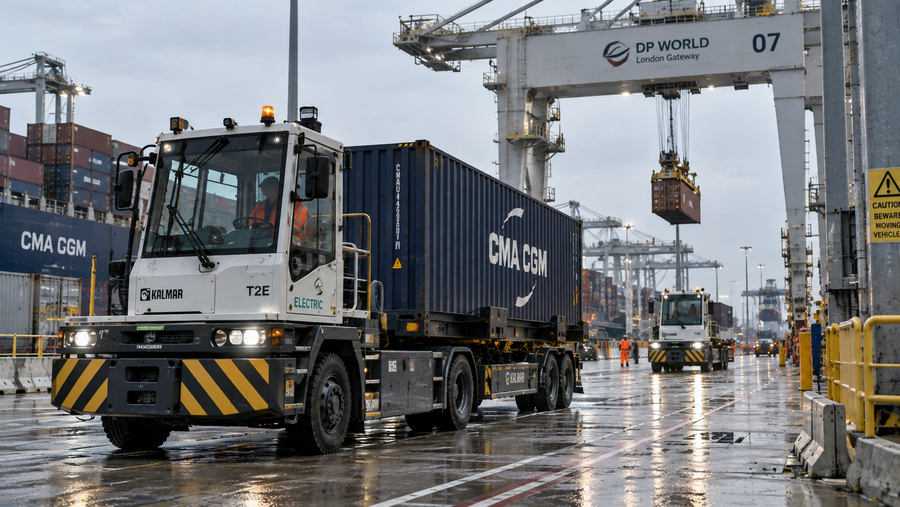

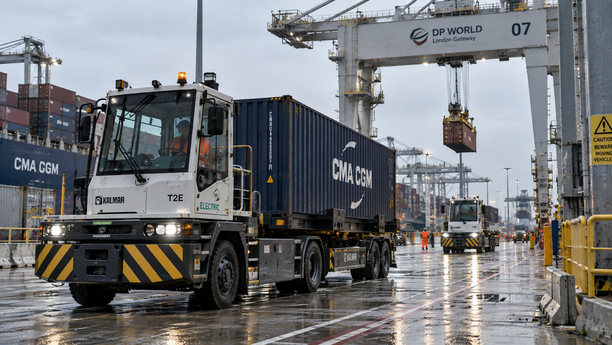
Battery-electric container-handling equipment is moving beyond small trials into sizeable operating fleets. That puts greater attention on sources of energy loss, including tyres. Manufacturers already connect rolling resistance and heat control with equipment efficiency, but the evidence does not yet show that port operators are systematically rewriting tyre procurement specifications around electrification.
Port electrification is beginning to reach a scale at which the efficiency of individual components deserves closer examination.
APM Terminals Elizabeth announced agreements in August for 96 Orange EV electric terminal tractors and 34 Konecranes electric rubber-tyred gantry cranes. Separately, APM Terminals has a framework agreement with SANY Marine under which it plans to replace about 500 diesel-powered terminal tractors across its global network with battery-electric models by 2030.
In Malaysia, Port of Tanjung Pelepas has commissioned the first 21 electric prime movers from a 52-unit order, with the remaining 31 scheduled for delivery by the end of September 2026. PTP says proof-of-concept testing found monthly operating costs per electric unit were 57% lower than for its conventional comparison unit, alongside a 48% reduction in carbon dioxide equivalent emissions.
The trial does not break out the contribution of tyres or rolling resistance to those savings. What it does demonstrate is the attention operators are giving to the operating economics of electric equipment as deployment moves towards larger fleets.
The technical argument around tyres is not new, but some manufacturers are already describing their products in terms directly relevant to battery-electric machinery.
Michelin's current terminal-tractor guidance states that tyres for electric terminal tractors should combine low rolling resistance, to maximise battery range, with the durability and traction required in port service.
Similar positioning is visible elsewhere in the industrial tyre sector.
Trelleborg says the construction and compound used in its XP1000 material-handling tyre provide very low rolling resistance, which it links to additional battery capability for electric forklifts and reduced fuel consumption on internal-combustion equipment. Trelleborg also claims the tyre offers 21% greater temperature resistance than competing brands in maximum-intensity applications.
GRI makes a comparable efficiency argument for its Ultimate Green XT solid tyre. The manufacturer claims a 20.4% reduction in rolling resistance, linking the improvement to energy savings for electric and internal-combustion forklifts. It also identifies reduced heat build-up as a characteristic intended to support intensive operation.
MAXAM provides another numerical example. In TÜV testing cited by the manufacturer, a material-handling tyre using its EcoPoint3 compound recorded a 51% rolling-resistance improvement against MAXAM's standard compound and 39% against the competitor tyres tested. The same programme reported improved endurance.
Those figures cannot be converted directly into equivalent increases in battery runtime. They come from industrial tyre comparisons rather than a defined port terminal-tractor duty cycle, while rolling resistance accounts for only part of a machine's total energy demand.
They establish something narrower: tyre construction can produce measurable differences in an energy-consuming characteristic of industrial equipment.
Heat control also needs careful definition. Manufacturers discussing reduced heat generation or greater temperature resistance are principally addressing tyre performance, endurance and service life. That is separate from battery thermal management and does not establish a tyre-to-battery heat relationship.
What is less clear is whether these characteristics are receiving greater formal weighting from terminal operators when tyres themselves are specified.
APM Terminals' experience at Pier 400 in Los Angeles provides useful evidence of how electric-equipment procurement is developing. Its first 20 Orange EV terminal tractors, deployed from April 2025, accumulated 42,000 operating hours with average uptime of 98.8%. APM subsequently ordered another 40 units, taking the planned electric fleet to 60.
Managing director Jon Poelma said the procurement was based on 12 months of real-world performance data. APM also says its purchasing approach evaluates total value over the life of the asset, including performance metrics, spare-parts availability and service-response standards rather than unit cost alone.
That shows electric-equipment procurement being informed by measurable operating performance. It does not show APM assigning a new standalone weighting to tyre rolling resistance.
The distinction is also visible in wider industry standardisation.
The Zero Emission Port Alliance's voluntary standards for battery-electric terminal tractors and straddle carriers were developed partly to support equipment procurement and address barriers including interoperability, cost and scalability. The standards examine three principal areas: charging strategy and method, charger and equipment architecture, and battery specifications. Tyres are not among the areas covered by the published framework.
That omission is not evidence that tyres are unimportant. It shows where the port industry's immediate standardisation effort has been concentrated as operators and manufacturers try to scale battery-electric container-handling equipment.
Ports already require tyres to deliver durability, load capacity, traction, resistance to damage and acceptable operating cost. Electrification does not remove those demands, and lower rolling resistance would have limited value if achieved at the expense of reliability in severe terminal service.
What changes is the visibility of energy performance.
As electric terminal tractors and other battery-powered machinery move into high-utilisation fleets, an operator assessing equipment through uptime, lifecycle cost and energy consumption has reason to understand whether different tyre specifications produce a meaningful change in electricity use.
Publicly available evidence from the deployments examined by TNM does not yet establish that this has become a formal replacement-tyre procurement criterion. Nor do current ZEPA standards create such a requirement.
For tyre manufacturers, the next convincing step will not be another generic claim about EV efficiency. It will be terminal-specific operating data showing what a change in rolling resistance delivers in energy consumed, operating hours, charging requirements or cost per container move, while preserving the durability and safety performance ports already demand.
Until that evidence emerges, tyre energy efficiency is under greater scrutiny. It is not yet a proven new port-industry specification.
Tags: port electrification, electric terminal tractors, industrial tyres, rolling resistance, tyre energy efficiency, battery-electric equipment, port equipment tyres, material handling tyres, APM Terminals, Port of Tanjung Pelepas, ZEPA
Editorial Standards & Disclaimer
Tyre News Media is an independent industry publication. Our reporting is based on information available at the time of publication, including company announcements, regulatory filings, official data, research and other sources considered reliable.
Articles may include independent analysis and editorial interpretation. Where appropriate, company statements and third-party claims are attributed to their source. Analysis, estimates and forward-looking observations should not be read as statements of established fact.
Tyre News Media takes reasonable steps to ensure accuracy but welcomes corrections, clarifications and responses from organisations or individuals covered in our reporting. If you believe information is inaccurate or requires clarification, please contact info@tyrenews.co.uk. Material errors will be corrected as appropriate.
Commercial relationships, advertising and sponsorship do not determine Tyre News Media's editorial coverage or conclusions.

_0%20(1).png)












%20(1).jpg)
%20(1).jpg)
%20(1).png)