


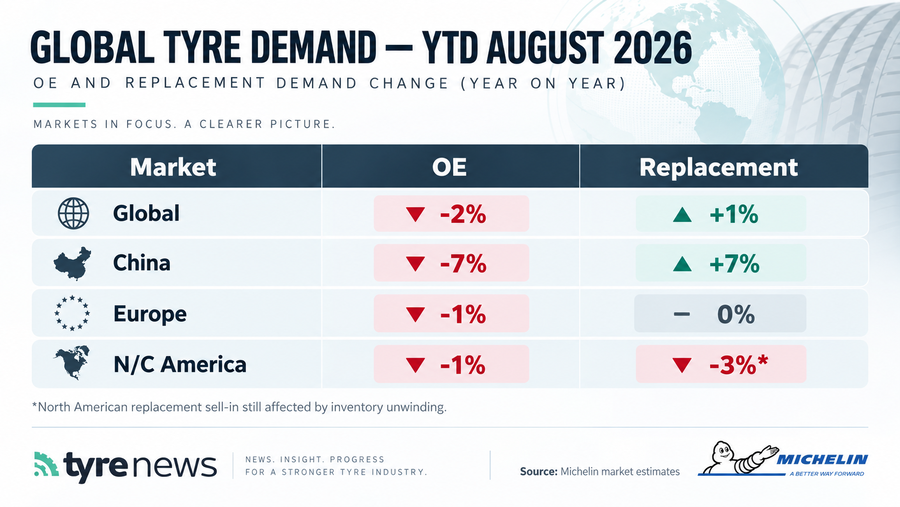

Global passenger-car and light-truck original-equipment tyre demand fell 2% year to date through August, while replacement sell-in increased 1%, according to Michelin’s latest market estimates.
The August 2026 dataset, published on 21 September, shows a marked difference between demand from vehicle manufacturers and the replacement channel, as well as substantial variation between major regions.
China recorded the sharpest divergence. OE demand was down 7% cumulatively through August, compared with the same period of 2025, while replacement sell-in increased 7%.
Michelin said the Chinese OE market had been affected by less favourable incentives for new-vehicle purchases than in 2025. In replacement, it pointed to a positive macroeconomic environment and “the replacement effect of the many new vehicles delivered over recent years”.
Europe’s OE market was down 1% year to date, while replacement demand was unchanged. Michelin described European replacement demand as broadly stable, despite fluctuations in tyre imports during the period.
North and Central America also recorded a 1% decline in OE demand, but replacement sell-in was down 3%.
Michelin said the North American replacement decline mainly reflected the progressive reduction of surplus Asian tyre inventories accumulated during the first half of 2025. That effect is gradually normalising, meaning current sell-in figures need to be read partly in the context of stock movements through the distribution chain rather than solely as an indication of underlying end-user demand.
That distinction is important because Michelin’s market estimates measure tyre sell-in. They combine figures published by local tyre-manufacturer associations with Michelin estimates for manufacturers outside those associations, based primarily on import-export statistics. Michelin says the figures are expressed in tyre units and may subsequently be revised.
Michelin’s global tyre-market data therefore provide a measure of tyres moving into the market rather than direct consumer sell-out.
The difference between OE and replacement demand can affect manufacturers differently according to their sales mix. Continental, for example, says 76% of its Tires sales in 2025 were generated by replacement business, against 24% from vehicle manufacturers.
That does not mean weaker OE conditions automatically benefit manufacturers with greater replacement exposure. It does show why headline global tyre-demand figures can conceal materially different commercial conditions across companies and channels.
Michelin’s first-half results also illustrated the channel split. MICHELIN-brand replacement volumes increased by 5%, while the group reported a 0.9% negative volume effect overall, reflecting weaker OE and Tier-3 volumes.
Pirelli’s July 2026 Market Watch provides separate evidence of the same broad divergence. Its estimates showed global car-tyre OE demand down 3% year to date and replacement demand down 1%, with China replacement demand up 4%.
Pirelli’s figures cover a different reporting period and should not be treated as directly interchangeable with Michelin’s August dataset. They nevertheless reinforce the broader picture of weaker OE demand alongside substantially different replacement trends between regions.
Michelin’s August figures do not yet establish a lasting structural shift towards replacement demand. North American sell-in remains affected by inventory adjustment, while part of China’s replacement growth reflects the replacement effect of vehicles delivered in previous years.
They do, however, show why tyre demand in 2026 cannot be reduced to a single global growth figure. OE, replacement and regional markets are moving at different speeds, making channel exposure increasingly important when assessing manufacturer performance.
Tags: Michelin tyre market data, global tyre demand, replacement tyre demand, OE tyre demand, passenger car tyres, light truck tyres, China tyre market, European tyre market, North America tyre market, tyre sell-in 2026, replacement tyres
Editorial Standards & Disclaimer
Tyre News Media is an independent industry publication. Our reporting is based on information available at the time of publication, including company announcements, regulatory filings, official data, research and other sources considered reliable.
Articles may include independent analysis and editorial interpretation. Where appropriate, company statements and third-party claims are attributed to their source. Analysis, estimates and forward-looking observations should not be read as statements of established fact.
Tyre News Media takes reasonable steps to ensure accuracy but welcomes corrections, clarifications and responses from organisations or individuals covered in our reporting. If you believe information is inaccurate or requires clarification, please contact info@tyrenews.co.uk. Material errors will be corrected as appropriate.
Commercial relationships, advertising and sponsorship do not determine Tyre News Media's editorial coverage or conclusions.


_0%20(1).png)

















%20(1).jpeg)

.png)