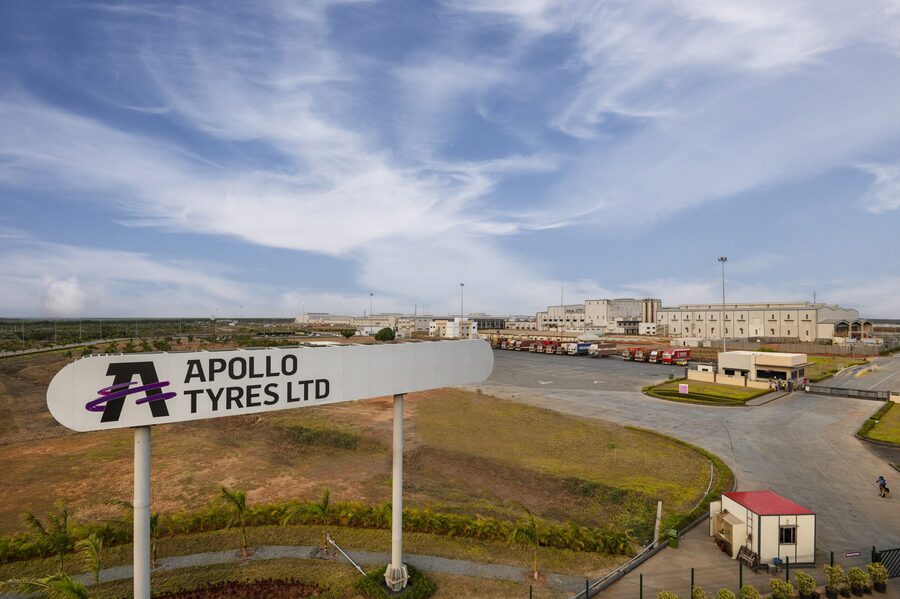

Apollo Tyres will source part of its European agricultural tyre range from external manufacturing partners after closing production at Enschede in the Netherlands. The decision reflects the economics of replacing relatively small specialist capacity and marks a significant change in how Apollo will serve parts of the European agricultural tyre market.
Apollo Tyres is turning to external manufacturing for selected high-end agricultural tyres after concluding that recreating the specialist capacity lost with the closure of its Enschede factory would not generate sufficient economic returns.
Production and related activities at Apollo Tyres (NL) BV ended at close of business on 30 June 2026, completing a closure process first announced in April 2025 and subsequently approved by the company's Works Council and Supervisory Board.
The Dutch factory produced about 750,000 tyres in its previous year of operation. Apollo began transferring production from the site in September 2025, with the wider transition expected to be substantially completed by September or October this year.
Most transferable production is being moved to Apollo's Gyöngyöshalász factory in Hungary. Lower-end 14- and 15-inch passenger car tyres are being transferred to India, while Spacemaster spare tyre capacity has been established at Baroda with the necessary OE approvals.
Agricultural tyres present a more complicated manufacturing problem.
Enschede had agricultural tyre capacity of about 20 metric tonnes a day, including specialist products not manufactured elsewhere within Apollo's network. Recreating such a relatively small operation at another factory would require investment without providing the scale needed to make the additional capacity attractive.
Chief financial officer Gaurav Kumar told analysts that Apollo had therefore identified an offtake partner for high-end agricultural tyres. External supply arrangements are expected to represent around 20–25% of the company's agricultural tyre volumes in the medium term.
The decision is commercially significant because it changes the question facing Apollo from where to relocate production to which products it still makes economic sense to manufacture itself.
For a specialist agricultural range, low production volumes, multiple sizes and applications, OE requirements and manufacturing complexity can make dedicated capacity considerably harder to justify than higher-volume passenger car production.
That makes external sourcing a capital-light solution, but one that transfers part of the manufacturing equation to third parties. Product consistency, lead times, supplier capacity and margin will consequently become important measures of whether the new model can replace Enschede effectively.
Apollo's agricultural business declined by high single digits year on year during the first quarter of its 2026–27 financial year, with management identifying the European agricultural transition as one factor behind the weaker performance.
The company nevertheless expects to retain most product categories previously produced at Enschede because equivalent manufacturing capability exists in Hungary or India.
The exception is likely to be parts of the agricultural and off-highway portfolio where there is no straightforward internal replacement. Apollo has acknowledged that some business could be surrendered, particularly unprofitable OE contracts.
That distinction matters. Rather than attempting to preserve Enschede's entire product and customer portfolio at any cost, Apollo appears prepared to use the restructuring to determine which business warrants retaining.
Agricultural tyres account for around 12% of Apollo's overall revenue, according to management, with approximately half of that contribution coming from OE customers. That puts agricultural OE at roughly 5–6% of group revenue.
The external manufacturing strategy therefore provides a way to preserve selected specialist products without committing capital to a replacement factory or production line. At the same time, withdrawing from uneconomic OE contracts could improve the quality of the remaining business even if it reduces volumes.
For distributors, the more immediate issue will be continuity. Moving from an established European factory to a combination of Apollo plants and external production introduces new supply routes that will have to settle before the effect on availability and lead times becomes clear.
The development also underlines the pressures facing European tyre manufacturing, where energy, labour and competitive costs are increasingly influencing decisions about which products are economical to manufacture locally.
Apollo's decision to close Enschede followed a review of its European manufacturing footprint against a difficult operating environment.
The company cited higher energy and labour costs, macroeconomic disruption, weaker demand for Spacemaster and agricultural tyres and price pressure from lower-cost competitors. Management concluded that the conditions were structural enough to make continued production at the Dutch site uneconomic.
Labour inflation was a particular concern. During Apollo's May 2026 earnings call, management said salary inflation in the Netherlands had reached approximately 12–13% over the preceding two to three years, compared with a more typical compounded rate of around 4–5%.
The closure is expected to affect around 500 jobs.
Apollo recognised a non-cash write-off of approximately €43 million against the fixed assets at Enschede during the final quarter of its 2025–26 financial year. It also provided for more than €55 million of cash-related closure costs, including around €50 million associated with the employee social plan.
Those costs make the restructuring expensive in the short term. Apollo's calculation is that concentrating production at more competitive plants should ultimately outweigh the cost of withdrawing from Enschede.
Management expects the restructuring to begin benefiting the profitability of its European operations during the second half of the 2026–27 financial year, once transferred production has stabilised.
The closure should not be read as Apollo withdrawing from European manufacturing.
Hungary remains central to the group's regional production strategy, with Gyöngyöshalász taking a larger role in passenger car tyre manufacturing. India is simultaneously becoming more important to European supply, including selected passenger car products and other transferred production.
Apollo has also been shifting truck and bus radial production from Hungary to India. Taken together, the moves point to a more specialised manufacturing network in which production is allocated according to cost, scale and factory capability rather than necessarily remaining close to the end market.
The agricultural tyre decision takes that strategy a step further by moving some production outside Apollo's own manufacturing network.
It is also relevant to the wider agricultural and off-highway tyre market, where specialist product requirements have to be balanced against considerably lower volumes than mainstream passenger tyre manufacturing.
For Apollo, the next test will be whether its external partners can provide the specialist capability previously available at Enschede without compromising supply reliability or the economics that prompted the restructuring in the first place.
For distributors and agricultural OE customers, the transition will be worth watching for a different reason. Apollo is not simply moving a factory's output from one country to another. It is redrawing the boundary between what it considers strategically worthwhile to manufacture internally, what can be sourced from partners and what business it is prepared to relinquish.
Tags: Apollo Tyres, Enschede tyre plant, agricultural tyres, agri tyres, tyre manufacturing, European tyre industry, off-highway tyres, Apollo Hungary, tyre supply chain, agricultural OE tyres
Editorial Standards & Disclaimer
Tyre News Media is an independent industry publication. Our reporting is based on information available at the time of publication, including company announcements, regulatory filings, official data, research and other sources considered reliable.
Articles may include independent analysis and editorial interpretation. Where appropriate, company statements and third-party claims are attributed to their source. Analysis, estimates and forward-looking observations should not be read as statements of established fact.
Tyre News Media takes reasonable steps to ensure accuracy but welcomes corrections, clarifications and responses from organisations or individuals covered in our reporting. If you believe information is inaccurate or requires clarification, please contact info@tyrenews.co.uk. Material errors will be corrected as appropriate.
Commercial relationships, advertising and sponsorship do not determine Tyre News Media's editorial coverage or conclusions.















%20(1).jpeg)