
European tyre distributors face a new product compliance challenge as Euro 7 brings tyre abrasion into the regulatory framework from 2028. With UNECE work on passenger-car tyre limits now advanced and manufacturers including Giti publicly preparing for the change, wear performance is moving beyond a durability claim to become a factor determining which tyres can legally reach the EU market.
For decades, tyre manufacturers have balanced competing demands around grip, rolling resistance, mileage, noise and cost. Euro 7 adds another constraint: abrasion performance will become a regulatory requirement.
Regulation (EU) 2024/1257 brings tyre wear within the European framework for non-exhaust vehicle emissions, alongside brake particle emissions. For tyre businesses, the significance is less about the environmental terminology than the commercial consequence. Products that cannot meet the applicable abrasion requirements will ultimately lose access to the EU market.
That creates a different proposition from the familiar EU tyre label. Wet grip, rolling resistance and external noise help buyers compare products; Euro 7 abrasion requirements will increasingly determine whether a tyre can continue to be placed on the market at all.
The timetable gives manufacturers and distributors time to adjust, but the first deadline is now less than two years away.
For C1 passenger-car tyres, new tyre types must comply from 1 July 2028. From 1 July 2030, non-compliant C1 tyres can no longer be placed on the market, although qualifying existing stock may continue to be made available until 30 June 2032.
C2 light commercial vehicle tyres follow two years later. New types come within the rules from 1 April 2030, the placing-on-the-market restriction applies from 1 April 2032, and the final transitional date for making non-compliant tyres available is 31 March 2034.
C3 truck and bus tyres follow from 1 April 2032 for new types and 1 April 2034 for the wider market restriction, with the corresponding transitional period ending on 31 March 2036.
Those distinctions matter. “Placing on the market” and subsequently “making available on the market” are not interchangeable concepts, so distributors will need to understand precisely how transitional provisions affect stock already within the European supply chain.
The regulatory picture has also moved considerably during 2026.
UNECE announced in March that proposed abrasion limits had been agreed for new C1 tyres covering passenger cars and vans, following the earlier development of harmonised abrasion measurement methodology. The proposal uses a Standard Reference Test Tyre as the benchmark and introduces an abrasion index against which candidate tyres can be assessed.
The regulatory proposal sets a baseline abrasion index of 1.00 for normal and snow tyres, with adjustments for defined categories including reinforced or extra-load tyres, severe-snow tyres, certain high-speed low-profile fitments and tyres with low load indices.
A second stage tightens requirements for some tyre groups, meaning abrasion compliance should not be viewed simply as a one-off 2028 hurdle.
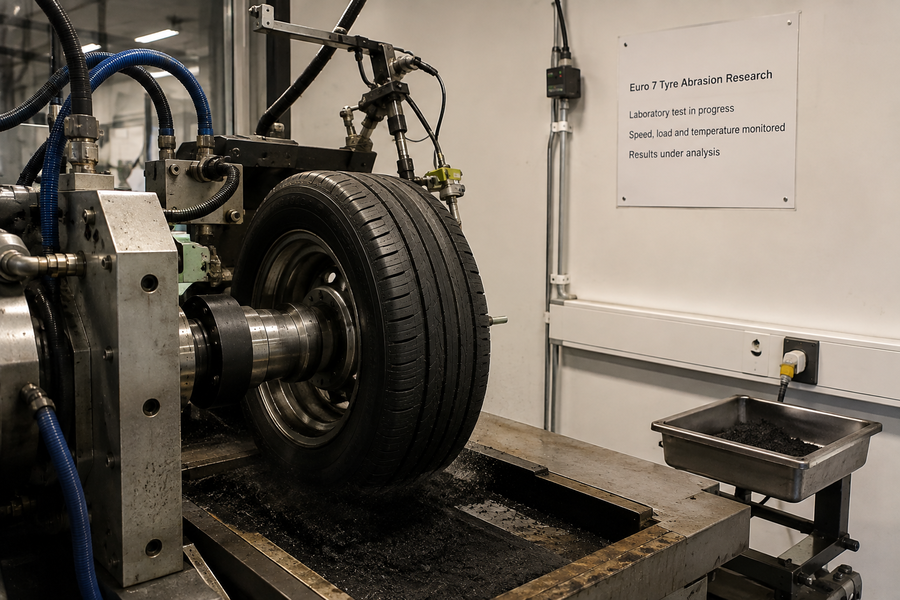
Testing can use an on-road circuit or an indoor drum facility where equivalence requirements are met. Earlier UNECE methodology established an 8,000km open-road convoy procedure and a 5,000km laboratory drum route, with tyre mass loss normalised against distance and load.
This is commercially important because abrasion is becoming a standardised performance characteristic rather than an internally defined manufacturer claim.
For the replacement market, that should eventually create another layer of technical data flowing from manufacturers through wholesalers, purchasing groups, fleet providers and retailers.
Tyre News Media recently examined how the Fraunhofer TERIS project is developing laboratory approaches to tyre abrasion, highlighting the wider technical challenge of correlating compound behaviour with finished-tyre wear under representative operating conditions.
The most important implication for the trade may not be testing itself. It is product lifecycle management.
A tyre range that is commercially viable today could contain patterns, constructions or individual sizes that require modification, replacement or withdrawal as the Euro 7 deadlines approach.
That makes compliance potentially a size-by-size issue rather than simply a brand-level question.
Distributors therefore need visibility over manufacturers' product roadmaps well before 2028. Purchasing decisions made during the next two years could affect stock positions extending into the compliance period, particularly for slower-moving passenger-car sizes.
The danger is assuming that a familiar pattern name automatically means uniform regulatory status across every size and specification.
As manufacturers renew ranges, some sizes may migrate quickly to compliant constructions while lower-volume fitments could be rationalised or discontinued. That could leave distributors balancing declining demand for outgoing products against the risk of holding inventory too deep into the transition.
The strongest suppliers will therefore need to provide more than a general statement that their ranges are “Euro 7 ready”. Wholesalers will increasingly need clear compliance information at SKU level, together with replacement schedules for affected products.
Giti Tire's public support for the emerging abrasion framework is notable less because one manufacturer has welcomed another regulation and more because it shows how tyre makers are beginning to reposition wear as a measurable environmental and product-development attribute.
The underlying engineering challenge is familiar. Reducing abrasion cannot be pursued independently of wet grip, rolling resistance, handling, durability and cost.
In effect, Euro 7 makes one part of that optimisation exercise externally enforceable.
That fits with wider changes already visible in Giti's European portfolio. Tyre News Media has reported on the company's A-rated Ecoroad truck tyre programme, where rolling resistance, mileage and fleet CO₂ performance are increasingly being presented together rather than as isolated product characteristics.
The direction is significant. Manufacturers will increasingly have to demonstrate that improvements in one environmental metric have not simply transferred the compromise elsewhere.
For distributors, this means product comparison could become more complex rather than less.
A tyre offering excellent wet grip and rolling resistance will not necessarily be the strongest abrasion performer. Equally, low wear alone does not make a tyre commercially attractive if the engineering required to achieve it compromises another attribute valued by fleets or motorists.
There is another implication that may ultimately prove more important at dealer level.
Tyre wear has traditionally been discussed largely through mileage, durability and cost per kilometre. Regulation introduces an environmental dimension to essentially the same physical process.
That could give manufacturers an opportunity to connect abrasion performance with total cost of ownership. A tyre that wears slowly can potentially combine longer replacement intervals with reduced material loss, although regulatory abrasion performance and real-world mileage should not automatically be treated as identical measures.
Fleet procurement is likely to be one of the first areas where the distinction matters.
Large fleets and public-sector buyers increasingly combine operating-cost targets with environmental reporting requirements. Once standardised abrasion information becomes available, tyre wear could enter tender specifications alongside rolling resistance, retreadability, lifecycle data and CO₂-related measures.
Retail customers may take longer to engage with the subject, particularly if abrasion performance is not incorporated directly into the consumer-facing tyre label. Dealers should therefore avoid turning Euro 7 into another unexplained technical acronym.
The more useful conversation will be about durability, environmental impact and whether a product belongs to the manufacturer's next generation of compliant ranges.
There will inevitably be a wave of “Euro 7-ready” product messaging as 2028 approaches.
Distributors should look beyond the badge.
The practical questions are whether compliance applies to the complete range, which sizes have been tested or approved, whether existing patterns will be replaced, and how manufacturers intend to handle products affected by later-stage requirements.
Internal product systems may also need attention. If abrasion approval information becomes another relevant attribute attached to tyre specifications, wholesalers and purchasing groups will need to ensure it can move accurately through catalogues, B2B platforms, ERP systems and customer documentation.
That transition mirrors the broader move towards richer tyre lifecycle information, including RFID and digital product identification.
It also creates a potential competitive divide. Large distributors with sophisticated product databases may be able to identify ageing inventory and migrate customers towards compliant replacements relatively quickly. Smaller operators relying heavily on supplier catalogues may have less visibility over which products face regulatory transition.
The dates built into Euro 7 can make tyre abrasion regulation appear distant. Commercially, it is not.
Passenger-car product cycles, homologation programmes and wholesale inventory decisions operate over several years. By the time the first C1 requirement takes effect in July 2028, many of the tyres that will define manufacturers' compliant ranges will already have passed through development and approval programmes.
The next phase should therefore shift attention from broad commitments to evidence.
Manufacturers will need to explain which ranges meet the emerging requirements. Distributors will need to map those answers against their inventories. Fleet buyers will begin asking how abrasion relates to mileage and whole-life cost. And the industry will need to distinguish genuine regulatory compliance from marketing language built around it.
Tyre News Media has previously examined why tyre wear is moving into the EU regulatory spotlight. The development since then is that the discussion is moving from whether abrasion should be measured to how limits will affect products reaching the market.
For the tyre trade, that changes the question.
Euro 7 is no longer simply something manufacturers' technical departments need to prepare for. It is becoming a portfolio-management issue for the entire European distribution chain.
The businesses best prepared for 2028 will be those that start asking manufacturers for size-level answers now.
Tagged with: Euro 7, tyre abrasion, tyre wear emissions, non-exhaust emissions, tyre distributors, tyre wholesalers, C1 tyres, C2 tyres, C3 tyres, microplastic pollution, tyre type approval, Giti Tire
Editorial Standards & Disclaimer
Tyre News Media is an independent industry publication. Our reporting is based on information available at the time of publication, including company announcements, regulatory filings, official data, research and other sources considered reliable.
Articles may include independent analysis and editorial interpretation. Where appropriate, company statements and third-party claims are attributed to their source. Analysis, estimates and forward-looking observations should not be read as statements of established fact.
Tyre News Media takes reasonable steps to ensure accuracy but welcomes corrections, clarifications and responses from organisations or individuals covered in our reporting. If you believe information is inaccurate or requires clarification, please contact info@tyrenews.co.uk. Material errors will be corrected as appropriate.
Commercial relationships, advertising and sponsorship do not determine Tyre News Media's editorial coverage or conclusions.

_0%20(1).png)












.png)
%20(1).jpg)
.jpeg)
.png)
%20(1).jpeg)

%20(1).jpeg)