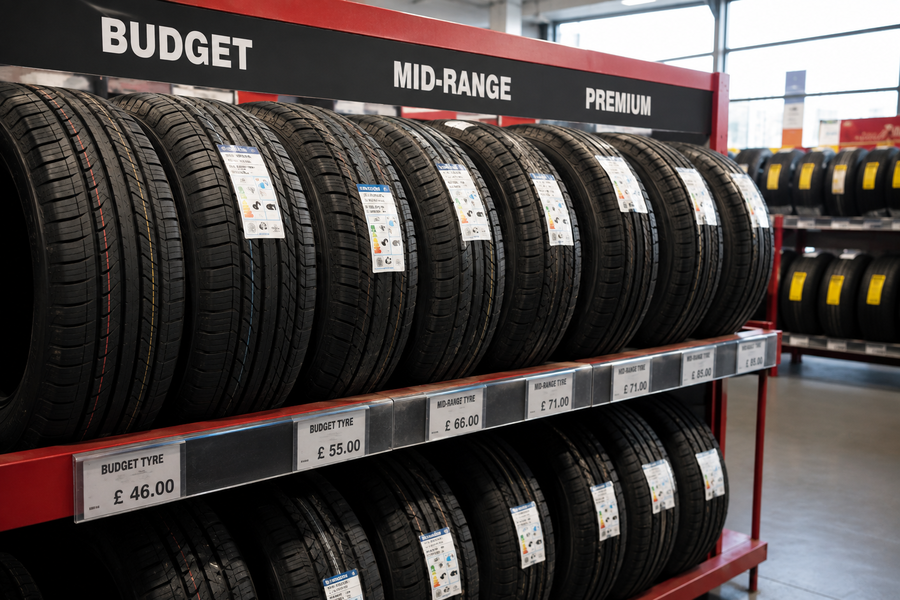

The traditional divide between premium, mid-range and budget tyres is becoming harder to defend as manufacturers improve products, widen fitment coverage and strengthen European distribution. For wholesalers and retailers, the change matters because price alone is becoming a weaker guide to where a tyre brand sits in the replacement market.
Budget tyres were once relatively easy to identify. They competed primarily on price, concentrated on mainstream replacement sizes and generally sat below recognisable mid-market brands.
That distinction is becoming less reliable.
The UK replacement market still talks in terms of premium, mid-range and budget, but there is no regulatory definition determining where one tier ends and another begins. More importantly, the products and businesses behind those labels are changing.
GfK data reported in 2024 put budget products at 43% of UK replacement tyre sales by unit during 2023, against 34% for premium and 23% for value and mid-range products. Budget gained two percentage points from the previous year.
Since then, replacement-market conditions have become more challenging. UK consumer replacement volumes fell 16% in the first half of 2025, according to British Tyre Manufacturers’ Association data cited in the source material, while European consumer replacement sales finished 2025 down 2%.
In a price-sensitive market, that makes the territory between an unknown low-cost product and a recognised premium tyre particularly valuable.
Price remains the simplest way to describe market tiers, but it is increasingly an imprecise measure.
A budget tyre for a large SUV can cost more than a premium product for a small hatchback. Wheel diameter, availability, promotions and supply conditions can all distort apparently straightforward price comparisons.
Purchase price also says relatively little about the complete proposition.
Wet grip, rolling resistance, expected mileage, noise, construction, warranty support and availability all influence value. Vehicle compatibility is becoming more important as well.
A manufacturer offering credible 18, 19 and 20-inch SUV fitments, EV applications and all-season tyres is addressing a more demanding part of the replacement market than one concentrated on basic small-car sizes.
Technical evidence further complicates the hierarchy. Competitive EU label results and credible independent testing do not automatically move a tyre into a higher market tier, but they make it harder to categorise products solely by price.
The result is an important distinction for the trade: low price and low capability are no longer necessarily the same thing.
The strongest challenge to traditional segmentation is coming from product development.
Manufacturers historically associated with value products are expanding into applications once dominated by premium and established mid-market brands, including larger SUVs, electric vehicles, higher-performance fitments and all-season tyres.
That puts brands from very different historical price positions into the same technical categories.
Tyre News Media has already examined how manufacturers are widening the European all-season tyre choice, including competition between Pirelli, Continental and Sailun.
Giti provides another example. Its GitiControl P10 covers 16 to 20-inch fitments, with many sizes achieving an A wet-grip label rating. The company has also been strengthening the manufacturing and sustainability credentials behind products supplied into Europe.
The significance is not that every technically improved value tyre should suddenly be called mid-market. Rather, the bottom of the market is becoming less uniform.
That creates a harder purchasing decision for retailers. The question is increasingly not whether a brand has historically been considered budget, but whether the current product provides sufficient performance and commercial support to justify recommendation.
Manufacturing capability alone does not determine where a tyre sits in the market.
Distribution can materially change how retailers perceive an unfamiliar or developing brand.
A product backed by dependable UK or European stock, regular deliveries, warranty handling, technical support and an established distributor gives a retailer greater confidence than one sourced intermittently through transactional imports.
That confidence has commercial value.
The trend is increasingly visible among manufacturers seeking stronger European positions. Sentury Tire’s Europe-first strategy combines distribution partnerships with consideration of regional manufacturing. Radar, meanwhile, passed 1,000 participating locations in its RED dealer programme across Europe in 2026.
For wholesalers and retailers, those developments change the proposition. A tyre backed by formal dealer infrastructure and predictable stock is commercially different from an anonymous container brand, even if both originated at the value end of the market.
Brand tiering is therefore becoming partly a supply-chain question.
Nowhere is the changing hierarchy clearer than among Chinese manufacturers.
For years, “Chinese tyre” was frequently used within the trade as shorthand for budget product. That description is becoming progressively less useful.
Chinese manufacturers differ significantly in scale, technology, international production, export experience and market positioning.
PRINX Chengshan, for example, reached 21st place in the 2025 global tyre manufacturing rankings reported by Tyre News Media, placing the company among the world's 25 largest tyre groups by sales. It is also expanding manufacturing outside China, including a new Malaysian plant planned with capacity for six million passenger tyres and 600,000 commercial vehicle tyres annually.
Other Chinese manufacturers are pursuing similar internationalisation strategies. Triangle Tyre has committed to a major Cambodia manufacturing project, while Sailun continues to expand both manufacturing capacity and European distribution relationships.
The implications go beyond additional factory capacity.
A Chinese-owned manufacturer can increasingly produce outside China, develop products for European requirements and sell them through established regional distributors. Country of ownership consequently tells dealers less about a tyre's market position than it once did.
Trade policy is making price-based definitions still less reliable.
The European Commission imposed definitive anti-dumping duties on passenger car and light-lorry tyres originating in China in July 2026.
Tyre News Media has examined how Chinese tyre import duties could reshape sourcing and pricing.
For manufacturers, trade measures strengthen the incentive to reconsider production geography and supply routes. For distributors, they add another variable to sourcing and pricing decisions.
They also expose a fundamental weakness in using retail price as a proxy for market position.
A tyre can become more expensive because of tariffs, logistics or manufacturing geography without becoming technically better. Conversely, manufacturing scale or lower production costs can allow a technically competitive tyre to remain relatively inexpensive.
Price can therefore indicate positioning, but it cannot define it.
The weaknesses in simple tiering become even more apparent in truck tyres.
Fleet operators have stronger reasons to look beyond initial purchase price because mileage, fuel consumption, casing durability, regroovability, retreadability and downtime all affect whole-life cost.
A cheaper new tyre producing fewer kilometres or little residual casing value can ultimately be more expensive. Equally, a competitively priced product delivering good mileage and a reusable casing can represent a strong fleet proposition.
That is why commercial tyre manufacturers increasingly compete on efficiency and lifecycle economics rather than headline price alone.
Giti's Ecoroad long-haul range, for example, includes A-rated rolling-resistance applications. The commercial test is whether those efficiency characteristics can be delivered alongside mileage, wet performance and casing durability.
For fleets, a relatively small difference in acquisition cost becomes less important when calculated against cost per kilometre.
That same principle increasingly applies to the wider tyre market. Value is moving from a simple question of what the tyre costs towards what the buyer receives for that cost.
The industry may therefore need a broader working definition of mid-market.
Price remains part of the equation, but a credible mid-market proposition increasingly combines repeatable product performance, meaningful range breadth, dependable supply, warranty and technical support, and enough evidence for dealers or fleets to recommend the tyre with confidence.
Independent testing can strengthen that case. So can established European distribution and mature aftersales structures.
For commercial products, casing performance and demonstrable whole-life economics become equally important.
None creates a formal boundary between budget and mid-market. That may be precisely the point.
Mid-market is not a technical certification. It is a commercial position built through product performance, distribution, dealer experience and customer acceptance.
Manufacturers can aim a brand towards the middle of the market. They cannot simply declare that it has arrived there.
This creates a particular challenge for established mid-range manufacturers.
Premium groups can continue to defend their positions through original equipment relationships, technology, brand recognition and specialist products. At the opposite end, enormous manufacturing scale supports aggressively priced replacement tyres.
Competition is becoming more intense between those two positions.
A value-focused manufacturer does not need to outperform every Michelin or Continental product to move upwards. It needs to offer enough capability, supply confidence and commercial reassurance for customers to question the premium attached to an established mid-market alternative.
That puts pressure on brands whose historic proposition has effectively been "better than budget, cheaper than premium".
The market is unlikely to abandon premium, mid-range and budget terminology. The labels remain useful shorthand for distributors, retailers and motorists.
But shorthand should not be confused with measurement.
As tyre capability converges and global manufacturers broaden their product and distribution strategies, the more useful question is no longer simply which tier a brand claims to occupy.
It is whether the product, supply chain and whole-life value justify that position. That is when a budget tyre stops being merely a budget tyre.
Tagged with: budget tyres, mid-range tyres, value tyres, UK replacement tyre market, Chinese tyre manufacturers, tyre wholesalers, tyre distribution, EV tyres, SUV tyres, truck tyres, tyre testing, whole-life tyre cost
Editorial Standards & Disclaimer
Tyre News Media is an independent industry publication. Our reporting is based on information available at the time of publication, including company announcements, regulatory filings, official data, research and other sources considered reliable.
Articles may include independent analysis and editorial interpretation. Where appropriate, company statements and third-party claims are attributed to their source. Analysis, estimates and forward-looking observations should not be read as statements of established fact.
Tyre News Media takes reasonable steps to ensure accuracy but welcomes corrections, clarifications and responses from organisations or individuals covered in our reporting. If you believe information is inaccurate or requires clarification, please contact info@tyrenews.co.uk. Material errors will be corrected as appropriate.
Commercial relationships, advertising and sponsorship do not determine Tyre News Media's editorial coverage or conclusions.

















%20(1).jpeg)