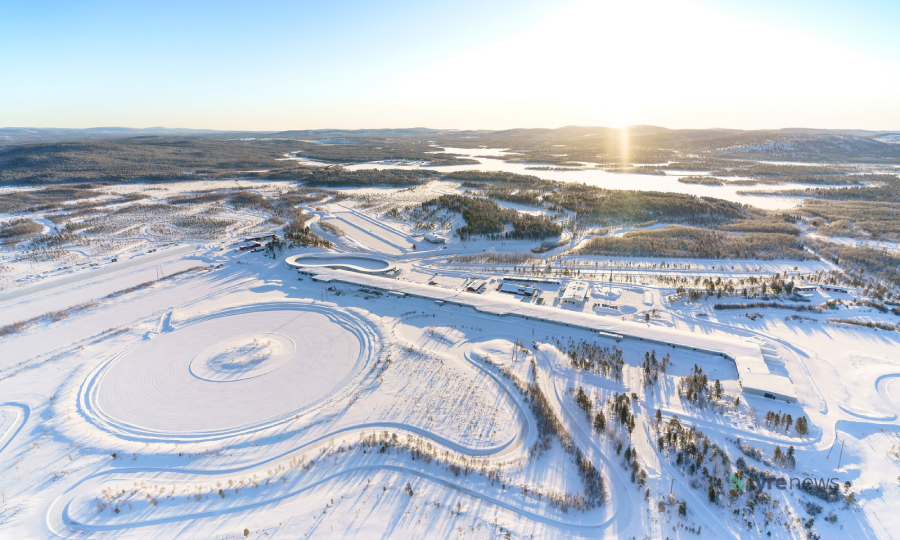

Deep in Finnish Lapland, UTAC Ivalo is reshaping how the tyre industry approaches winter product development. With the world's first fully integrated indoor winter testing ecosystem now operational, and new permanent facilities such as Nexen's Purple Snow Ivalo Center recently inaugurated on site, the proving ground offers a clear signal of where the winter tyre sector is heading: away from the seasonal campaign and towards continuous, data-driven engineering.
For decades, winter tyre development has been hostage to the weather. Engineers converged on northern proving grounds for a matter of weeks each year, compressing entire development programmes into whatever natural snow and ice the season provided. A poor winter or unstable conditions could set a programme back by a full year.
UTAC Ivalo's indoor concept fundamentally changes that dynamic. By carefully storing and managing snow from the start of the calendar year, the facility can recreate winter conditions on demand throughout all twelve months. Tyre makers can schedule development, benchmarking and correlation work at whatever point best suits their global research and development timetable, rather than around a narrow seasonal window.
The strategic consequences are significant. Brands can de-risk their programmes, distribute workload more evenly across the year, and react with far greater speed when regulatory or market demands shift unexpectedly.
A defining characteristic of UTAC Ivalo's indoor facilities is their commitment to repeatability. Outdoor winter testing will always involve a degree of variability. Changes in temperature, humidity, snowfall and sunlight can subtly alter the surface from one session to the next, introducing noise into engineering data that is difficult to isolate or control.
By managing snow type, layer thickness, temperature and surface preparation with laboratory-like precision, the indoor tracks deliver consistent grip levels and surface behaviour session after session. Engineers can run the same test configuration on successive days and be confident that any differences in measured performance originate from the tyre or vehicle, not from the test surface itself.
That degree of control enables finer-grained comparisons between tread patterns, construction types and rubber compounds. It supports more robust benchmarking against competitors. And it strengthens the correlation between on-track measurements, indoor rig tests and virtual simulation models. UTAC is, in effect, bringing lab-grade rigour into a full-scale proving ground environment, tightening the link between objective instrumentation and subjective driver assessment.
The indoor halls are the headline attraction, but UTAC Ivalo's real strength lies in the wider ecosystem that surrounds them. The site combines long outdoor snow and ice routes for high-speed, real-world behaviour with specialised layouts such as snow flats, handling circles and low-friction surfaces designed for focused characterisation work. It accommodates both studded and non-studded tyres, reflecting Nordic regulatory requirements and the broader European market. Facilities for vehicle dynamics work, including ABS, ESC and advanced driver assistance systems, extend its usefulness beyond pure tyre evaluation.
By offering this range of environments on a single site, UTAC Ivalo allows engineers to build a complete picture of tyre behaviour. They can move from tightly controlled indoor sessions to more naturalistic outdoor driving, checking how small design changes identified in the hall translate onto longer, more varied routes. The key insight is that indoor precision and outdoor realism do not compete; each reinforces the other when they are part of a connected ecosystem.
The inauguration of Nexen's Purple Snow Ivalo Center illustrates a trend that extends well beyond any single manufacturer. Tyre brands are no longer simply booking track time at proving grounds; they are embedding themselves permanently within them.
By establishing a dedicated base inside UTAC Ivalo, Nexen effectively connects its global research and development network directly to an Arctic environment. Engineers can move between simulation offices, workshops, and indoor or outdoor tracks as a seamless workflow, using the Finnish site as a permanent extension of their main development centres rather than a remote seasonal outpost.
This model accelerates decision-making, because teams can iterate designs and validate changes without waiting for the next available track slot. It enables closer integration between compound laboratories, pattern design teams and vehicle testing operations. And it supports long-term data gathering on consistent surfaces, building a rich historical archive for correlation work and, increasingly, for training artificial intelligence models.
As more manufacturers choose similar arrangements, UTAC Ivalo begins to resemble a multi-tenant innovation hub rather than a traditional book-and-test proving ground. That shift in character matters for the industry as a whole.
Tyre development has become substantially more digital over the past decade. Manufacturers rely heavily on simulation, optimisation algorithms and AI-assisted design to explore large design spaces before a mould is ever cut. The challenge is that virtual models are only as reliable as the data used to build and validate them.
The controlled environment at UTAC Ivalo is well suited to closing that loop. When engineers can be confident that snow conditions, temperature and surface preparation are highly repeatable, they can generate cleaner, more reliable datasets to refine their simulation tools. Subtle pattern changes, new compound formulations or construction modifications can be correlated against on-snow results with much greater confidence than outdoor testing alone would allow.
Over time, this feedback cycle supports more accurate predictive models of winter performance, reduces the number of physical prototypes required to reach a validated product, and creates robust, model-based methods for translating performance outcomes across different markets and vehicle platforms. In the longer term, winter tyre testing is likely to be as much about feeding and validating digital twins as it is about conventional track sessions. UTAC Ivalo's infrastructure is already aligned with that trajectory.
When winter testing is both permanently available and highly repeatable, the tempo of product development changes. Teams no longer need to wait for the following winter season to validate a new idea. They can test, learn and iterate throughout the year.
Product cycles can shorten, with more frequent updates and mid-cycle improvements becoming commercially viable. Brands can respond more quickly to new safety or sustainability regulations. Differentiation can become more precise, with tyres tuned more specifically to vehicle type, driving region and driver expectations than would be possible under a campaign-based approach.
It also raises the competitive bar. Manufacturers that fully exploit year-round Arctic testing may be able to bring more refined products to market more quickly, putting pressure on those who have not yet made equivalent investments.
Climate variability is adding a layer of uncertainty to traditional winter testing. Warmer winters, rain events and unstable ice conditions have the potential to disrupt planned test weeks and undermine the long-term consistency of datasets built up over many years.
By recreating winter conditions indoors, UTAC Ivalo offers a measure of insulation from these risks. It cannot replace natural conditions entirely; long outdoor routes and real-world surfaces remain essential to a complete test programme. But it can stabilise the core of winter testing schedules in a way that pure outdoor operations cannot guarantee. As the climate becomes less predictable, that stability will be of increasing value to manufacturers trying to maintain rigorous winter validation.
Taken together, these developments point to a clear shift in the role of the winter proving ground. It is no longer simply the place where a tyre is signed off at the end of a project. Facilities such as UTAC Ivalo are becoming strategic hubs at the centre of year-round development: places where winter testing is continuous rather than seasonal, where indoor precision and outdoor realism work in combination, and where tyre manufacturers maintain permanent presences integrated with their global research and development operations.
The inauguration of the Purple Snow Ivalo Center, and the continued expansion of UTAC Ivalo's indoor capabilities, suggest this transformation is already well under way. For the winter tyre segment, where safety margins, driver confidence and regional specificity are paramount, the shift from an opportunistic seasonal campaign to a continuous, engineered process may prove to be one of the most consequential changes of the coming decade.
Related Stories on Tyre News:
Tagged with: winter tyre testing, UTAC Ivalo, Arctic proving ground, tyre R&D, indoor snow testing, 3PMSF certification, tyre development repeatability, digital tyre development, winter tyre compound, tyre benchmarking, year-round testing, climate-resilient testing
Editorial Standards & Disclaimer
Tyre News Media is an independent industry publication. Our reporting is based on information available at the time of publication, including company announcements, regulatory filings, official data, research and other sources considered reliable.
Articles may include independent analysis and editorial interpretation. Where appropriate, company statements and third-party claims are attributed to their source. Analysis, estimates and forward-looking observations should not be read as statements of established fact.
Tyre News Media takes reasonable steps to ensure accuracy but welcomes corrections, clarifications and responses from organisations or individuals covered in our reporting. If you believe information is inaccurate or requires clarification, please contact info@tyrenews.co.uk. Material errors will be corrected as appropriate.
Commercial relationships, advertising and sponsorship do not determine Tyre News Media's editorial coverage or conclusions.


_0%20(1).png)












.png)
%20(1).jpg)
.jpeg)
.png)
%20(1).jpeg)

%20(1).jpeg)